Sam on the AT – Into the land of Davy Crockett 10-3-09
Sam and Sallie arrived in the trail town of Damascus, Virginia on the 30th of September, right on schedule. Damascus is the last settlement on the Virginia section of the trail. They have completed 550-trail miles, all in the state of Virginia. Virginia was a lovely area with its’ rolling hills and mountains and well groomed trails, but too much of anything makes one long for a change. Well, if change was what our trekking pair was seeking, they found it in the mountains of northeastern Tennessee.
In 1989, Roland Mueser, a thru-hiker and retired physicist, did an extensive survey of 136 AT thru-hikers. (His findings are recorded in a fascinating book, Lessons from the Appalachian Trail). Mueser found that of the non-finishers (85 percent, in his study), 35 percent lost interest or became homesick. Time commitments to jobs or school forced another 25 percent off the trail. Sickness and injury derailed 17 percent. 10 percent couldn't stand the weather. And 10 percent ran out of money.
Entering the Cherokee National Forest, Sam and Sallie hiked the long ridge above the beautifully rugged shores of Watauga Lake. From this vantage point some 4000-feet in elevation, Sam could spot numerous landmarks 15-20 miles away in North Carolina. Ski areas and large blocks of condos built on the mountain sides were easily identified. One of the first trail shelters they passed was the Iron Mountain Shelter named for a mid-1800’s pioneer who had traveled west to win his fortune. Losing all of his money and belongings to robbers along his journey, he spent the rest of his life (40-plus years) as the Iron Mountain hermit. A plaque was placed on the trail in 1928 commemorating this fact. The trail in Tennessee has changed considerably from that of Virginia. It has narrowed somewhat and is not as well groomed. Not to say that the trail maintenance crews don’t work hard in Tennessee. The trail on these mountains is far more rugged and remote, making any efforts to maintain or improve much more difficult.
Leaving Iron Mountain, Sam and Sallie traversed Roan Mountain passing through numerous high country apple orchards along the trail. Roan Mountain, according to geologists is home to the oldest rock formations on the North American continent. One particular escarpment formed of Cranberry gneiss has been aged at over 1.5-billion years. Many of the older rocks found in Mississippi by comparison are youngsters in the 300-400-million year old age class. Roan Mountain summit is home to the world’s largest natural rhododendron garden covering several hundred acres. Early June is the time to visit to catch the blooms at their peak. Sam and Sallie would have to take the trail guides word on that one as they had to move on. Of particular note historically, is the Over Mountain shelter located near Hump Mountain. This shelter is a large barn that can sleep as many as 20-hikers. The Over Mountain area is known for its’ role in the Revolutionary War when the Over Mountain Men (settlers in the East Tennessee and Kentucky region) who being fed up with Britain’s constant harassment of their commerce, traveled across the mountains at this very spot to annihilate the English in the battle of Kings Mountain, North Carolina. The foothold they gained on the frontier helped open the door to mass westward migration in ensuing decades
Sam and Sallie, with the support of trail angels, made great time in this area covering 20-plus miles several days to keep Springer Mountain, Georgia in their sights for an October 31st finish. They “flip-flopped” and “slack-packed” most of the area down to Street Gap, about 20-trail miles south of Ervin, Tennessee. For the non-thru hikers reading this, “slack-packing” is hiking with minimal supplies in a day pack. You are dependent upon pre-arranged support from trail angels or friends to pick you up at rendezvous points and provide you with shelter and food for the night. Thus, you can hike without the encumbrances of extra days’ food, shelter, and bedding. “Flip-flopping” also requires logistical support from off-trail folks. For instance, Sam and Sallie hiked south on the trail to US Highway 19E near Elk City, North Carolina. They were picked up there by family, fed, and given a comfortable night’s rest off the trail. The next day, Sam and Sal were put on the trail at Roan Mountain and hiked back north to Highway 19E. They completed the same mileage, but ‘flip-flopped” their direction. Family connected with the pair that evening again near Elk City and put them back on the trail the next day at Roan Mountain, but this time headed south. One advantage to “flip-flopping” is that, at times, the hiker can start at the top a mountain and descend to a trail head below rather than having to climb that same mountain. It all makes for a welcome break from the day to day, up and down, some call “trudgery” combining the words trudging and drudgery.
San and Sallie now entered the state of North Carolina and the Pisgah National Forest. Hiking above 4000-feet for most days on a trail windy enough to twist a mule, the pair experienced mixed weather with fairly warm days interspersed with cooler rainy days. Rain seems to have become the by-word for this 2000-mile hike. So far it has rained for 57 of 130 days. Descending into Hot Springs, North Carolina gave Sam and Sallie a chance to check in with friends at the Nantahala Outdoor Center Outpost on the French Broad River. Hot Springs is situated in the beautiful valley of the French Broad about 40-miles northwest of Asheville. As the name suggests, the town is the home of a famous spa which grew up around the waters of the warm springs on the site. It is also where the Spanish explorer Hernando de Soto passed through in 1540. The AT passes right down Main Street and the trail register is located in the lobby of the post office.
Leaving Hot Springs Sam and Sallie traveled a fairly lazy trail for the next seven to eight miles, ascending only 700-feet in that distance. The fun was about to begin, however, at Bluff Mountain, the AT climbs over 2000-feet in just three miles. Eventually the hikers made it to Max Patch , a huge bald on top of Max Patch Mountain. Snow had fallen in the night as Sam and Sallie slept. They woke to about one-half inch of the white stuff. Just enough for great photo opportunities. The temps were in the low forties and the snow began to melt soon after sunrise. On Max Patch, Sam ran into forty or fifty section hikers in several groups. They were out to enjoy fall in the mountains.
Snowbird Mountain, a 4000-foot hump was the last mountain Sam and Sallie were to cross before entering the Great Smoky Mountain National Park at Davenport Gap. Dogs are not allowed on the AT in the park, so Sam met up with his dad at Waterville, Tennessee to hand off Sallie for a few days. Waterville is located at mile marker #1 on Interstate 40 in Tennessee. The Pigeon River puts Waterville on the map since it is the put-in for numerous rafting company operations. Sallie seemed happy to get a few days break from the trail. She got to lay around camp while Sam took on the Great Smokies.
After a night in a real bed (warm camper) Sam struck out solo on the AT through the Great Smoky Mountain National Park. He had budgeted five days in the park. After reaching the Cosby Knob shelter in a cold, driving rain, Sam decided that 8-miles was good enough for a start. That Monday morning brought over 8-inches of snow to the peaks in the park. Even in the snow he covered almost 20-miles going up to Icewater Spring shelter, aptly named for the existing conditions. Sam actually donned extra clothing for this part of his hike, putting on a set of poly-pro thermal bottoms under his light weight shorts. He also chose to put on a long sleeve poly shirt, after all, there was 8-inches of snow on the ground and the temps were in the upper 20’s with a northerly wind gusting to 10-miles per hour. Tough weather calls for extreme measures. He says that as long as you keep walking you stay warm.
The trails in the park are extremely well maintained and well used as literally thousands of hikers use these paths yearly. This day, however, only saw the hardiest hikers out. Sam ran into several south bound through hikers he had befriended at other points northward. They all made good time through the 5000-foot elevations of the Smokies. The second morning in the park, Sam awoke at 3:30 and hit the trail in the dark. He witnessed the awesomeness of the night sky unencumbered by pollution from man-made lights and smog. This was the night that the earth was passing near the tail of Haley’s comet which was in the news several years ago. Sam was treated to a spectacular “fireworks’ show as the meteor shower rained above. The scene was incomparable with the snow and ice reflecting the heavens and its shooting stars. He made 11-miles to Clingman’s Dome in time to watch the sun rise from the highest point on the Appalachian Trail at 6,643-feet. Soon after sunrise, the crowds started showing up and Sam hit the trail again, not stopping until he had made almost 30-miles on what he described as the coldest yet most beautiful day yet. The next day he descended Shuckstack Mountain into the Little Tennessee River Valley to cross Fontana Dam, the tallest dam east of the Mississippi. On his way down to the dam he crossed paths with several bears feeding on the acorns to be found on the lower slopes. They paid little attention to him walking just yards away as they were intent on putting on that extra weight to carry them through the winter.
At Fontana, Sam and his dad met up again, traveled to nearby Robbinsville for some good hot food and then on to the warmth and comfort of dad’s camper. As Sam approached the dam, dad and Sallie were on the dam walking towards him a couple of hundred yards away. Sam whistled and it was like a scene from a Disney movie as Sallie took off to greet her master. She was so glad to see him. They were a happy pair again.
Equipment wise, a few items are beginning to show some wear, but after almost 2000-miles that is expected. Sam’s shoes, the Keen Shellrock Mid Waterproofs are showing the most wear. The waterproofing on one shoe has failed and the soles of both have some issues. He is bound and determined to make these last to the end. These shoes would give the average person plenty of service, but on the trail, they see day after day of abuse by water and rocks, the likes of which we, as average folk, would never see. The only additional gear Sam has picked up is a liner for his sleeping bag. The liner not only protects the inside of the bag from dirt, but it also adds another 10-degrees of comfort to his 20-degree bag.
Food has really become easy now that Sam’s dad is in the area. He picks up Sam at trail-heads in the evenings and they make it to the nearest steak house or buffet to load up. Dad watches as Sam stokes his engine for the next day. Breakfast at the camper consists of 4-egg omelets, ten slices of Wright’s thick sliced bacon, and six or seven biscuits with Flo Strawn’s home made wild plum jelly. That holds him until his morning break on the trail when he consumes another couple of thousand calories all on the way to a ten to twelve thousand calorie day. When you’re hiking 15-20-miles per day you can get away with that kind of intake.
In the next installment Sam and Sallie will travel through the Nantahala Mountains of western North Carolina. By many accounts these mountains hold some of the most beautiful sights of any on our continent. It is, of course, peak fall color time and that in itself makes every vista spectacular.
Keep your emails coming to mclemoresam@yahoo.com. Sam thoroughly enjoys hearing from all of you. You can also read the complete adventure at http://samboat.blogspot.com/. In the words of the Appalachian Trail’s founding father, “To walk; to see and to see what you see.” –Benton MacKaye, on the ultimate purpose for hiking on the Appalachian Trail, 1971.
Remember Sam’s favorite saying:
Yard by Yard, Life is hard. Inch by Inch, Life’s a cinch!


Subscribe To


 Posts
All Comments
Posts
All Comments
About Me

AT Map
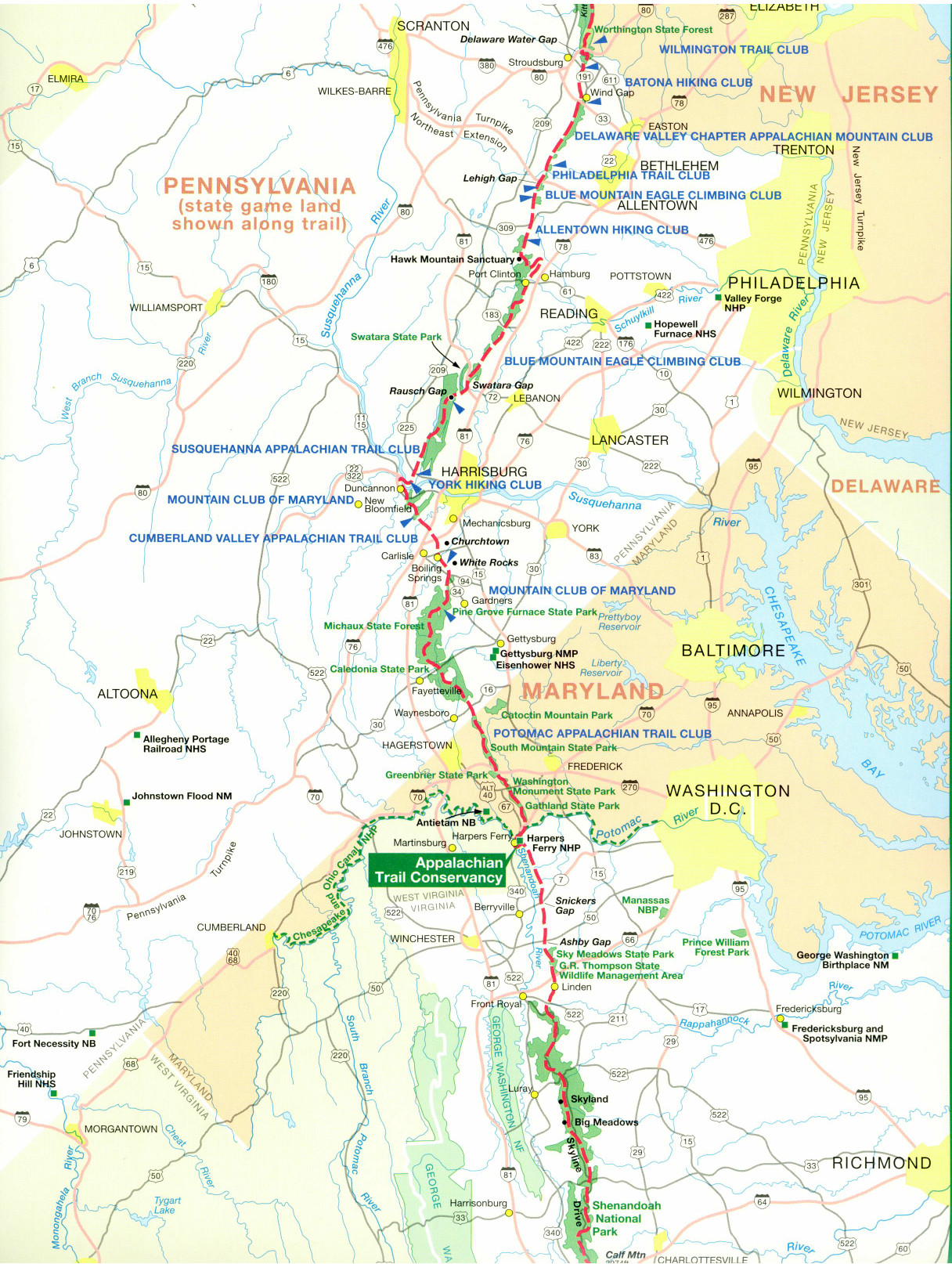
Pennsylvania-Maryland-West Virginia
Mt. Katahdin

The Knife Edge