When we last heard from Sam and his faithful lab mix 6-year old Sallie, they had re-united at Fontana Dam on the Little Tennessee River where the Appalachian Trail exits the Great Smoky Mountain National Park. Warmer weather was in store for the hiking pair, but, unfortunately, so was more rain. Sam and Sallie did quite a bit of “slack-packing on this section of trail. The Nantahala Mountains are one of the many sub-groups of peaks that comprise the Appalachian chain. The word Nantahala, as legend has it, is an Anglicization of the Cherokee term for “land of the noonday sun.” Just a short hike in these mountains, brings that phrase to life. Not only are the Nantahalas some of most heavily forested from Georgia to Maine, but they are very steep. The combination of these factors makes sunlight in the valleys somewhat of a rare commodity, at least until midday.
Sam and Sallie are just over 160-trail miles from their goal of Springer Mountain, Georgia. The morning they took to the trail at Stecoah Gap was a perfect cool, clear day. The hamlet of Stecoah, North Carolina could be seen clearly far down in the valley below. Sam had visited a local market the evening before and picked up a bag of fresh fruit and Snickers bars. At the trailhead signpost a hundred yards or so into the woods, he hung the bag of goodies – “a bit of “trail magic” for the hikers that followed him. It wasn’t the first time he had provided “trail magic” for his fellow hikers. He really enjoys receiving such surprises while out in the woods and thus he receives great satisfaction in returning the favors. Sallie probably is oblivious to the act, but goes along with it. When Sam’s happy, Sallie’s happy.
Just a few miles down the trail lies the Cheoah Bald, another of those mysterious open meadows atop the tall mountains. Mysterious because, no one really knows why the balds are there. They are all below the tree line and should be forested. Some believe they were created when lightning strikes long ago started fires that cleared these areas. Native grasses and wildflowers took over and created views reminiscent of scenes from the movie The Sound of Music. Native American storytellers tell that the balds were created by a great bird god as a place to land. Nevertheless, the balds are places of serene beauty that allow the visitor opportunities to take in unlimited vistas of distant peaks and valleys.
Sam and Sallie arrived at Wesser, North Carolina, the headquarters of the Nantahala Outdoor Center. They crossed the footbridge over the river in a drenching rain to be greeted by Sam’s Dad and copious amounts of warm delicious food in the nearby restaurant. Sam has worked for the Outdoor Center at their Chatooga River Outpost in South Carolina as a river guide for several seasons so he sees several of his buddies while in Wesser.
From Wesser, our hiking pair start another long ascent as they head southward. This time they’re headed to Wesser Bald. It’s this section of the Nantahalas that gives them the well deserved reputation as the most rugged section of the entire AT. The trademark of the AT here is switchbacks and steep slopes. By now, after 2050-trail miles, Sam and Sallie are prime condition to handle anything the trail gives them. The AT here bobs from the 700-800-foot levels up to 5000-feet time and time again as each mountain is checked off. Sam and Sallie hike for a few days with other SOBO’s (south bounders). One, going by the trail name of “Natty Bumppo” is from Michigan by way of Florida. You may recognize the name coming from James Fenimore Cooper’s character in The Leather Stocking Tales. Natty, the hiker had started as a NOBO (north bounder) earlier this year when he suffered a leg injury in Georgia. After rehabbing at home for several weeks, he traveled to Maine to restart his hike as a SOBO. He had made it south to this point without further injury. There was also another young man and a couple of female thru-hikers headed south on this section of trail. They would sometimes hike together, but mostly saw each other when one would stop for a break and another would catch up and or pass them. They all shared resources as well as knowledge of the trail. This is what the Appalachian Trail is about – meeting new friends who share many of the same ideals as you. Of course, Sallie proved to be their best, favorite friend. She loved sharing their leftovers with them.
Standing Indian Mountain, from where Sam and Sallie could see the Tallulah River Gorge to the southeast and the mountains of northern Georgia, the Foxfire country, to the south is well worth the climb. By now it was late October and the leaves were at their peak in this area. Long distance views caught all of God’s glory in the forest colors. There were the golds of the Beeches and Poplars, The almost maroon colors of the Oaks, and then a splash of the reddest red you could ever imagine – that would be a Maple. There was a breathtaking view every time it came into sight. Now our duo, departs the Standing Indian, leaving the Nantahalas behind as they come up on the Blue Ridge of North Georgia, passing on the way Chunky Gal Trail (now there’s a name to be reckoned with).
Sam’s food intake has increased since he usually gets two of his meals at the courtesy of his Dad who has been leap-frogging down the trail following them in the RV. When asked as to what he had missed most while on the trail, Sam first replied, “Isabel.” (his wife) and then said the next thing he missed was meat. So Dad tried to remedy that situation. We explored practically every BBQ house and steak house in the area. There are some truly great food experiences in this area of the country. There are also some disappointments. Needless to say, no one in the party ever went to bed hungry.
Equipment wise, the shoes are probably taking the worst beating. Sam is now wearing his third pair of Keene shoes and they have begun to leak in a couple of the seams. This is only a problem if it rains or when he crosses streams. Let’s just say here that it has rained more days than it has not and the mountain streams are all flowing at their springtime rates. The poncho and hammock are holding up well as is the back pack with no major problems. Sam did have to replace a basket or foot on one of his Leki hiking poles at Wesser, but with a lifetime warranty, it cost him nothing but a few minutes in the outfitter’s shop.
As they cross the Georgia state line, Sam and Sallie have just a little over 76-miles left in their 2178-mile, five million step journey.


Into the land of Davy Crockett 10-3-09
Sam on the AT – Into the land of Davy Crockett 10-3-09
Sam and Sallie arrived in the trail town of Damascus, Virginia on the 30th of September, right on schedule. Damascus is the last settlement on the Virginia section of the trail. They have completed 550-trail miles, all in the state of Virginia. Virginia was a lovely area with its’ rolling hills and mountains and well groomed trails, but too much of anything makes one long for a change. Well, if change was what our trekking pair was seeking, they found it in the mountains of northeastern Tennessee.
In 1989, Roland Mueser, a thru-hiker and retired physicist, did an extensive survey of 136 AT thru-hikers. (His findings are recorded in a fascinating book, Lessons from the Appalachian Trail). Mueser found that of the non-finishers (85 percent, in his study), 35 percent lost interest or became homesick. Time commitments to jobs or school forced another 25 percent off the trail. Sickness and injury derailed 17 percent. 10 percent couldn't stand the weather. And 10 percent ran out of money.
Entering the Cherokee National Forest, Sam and Sallie hiked the long ridge above the beautifully rugged shores of Watauga Lake. From this vantage point some 4000-feet in elevation, Sam could spot numerous landmarks 15-20 miles away in North Carolina. Ski areas and large blocks of condos built on the mountain sides were easily identified. One of the first trail shelters they passed was the Iron Mountain Shelter named for a mid-1800’s pioneer who had traveled west to win his fortune. Losing all of his money and belongings to robbers along his journey, he spent the rest of his life (40-plus years) as the Iron Mountain hermit. A plaque was placed on the trail in 1928 commemorating this fact. The trail in Tennessee has changed considerably from that of Virginia. It has narrowed somewhat and is not as well groomed. Not to say that the trail maintenance crews don’t work hard in Tennessee. The trail on these mountains is far more rugged and remote, making any efforts to maintain or improve much more difficult.
Leaving Iron Mountain, Sam and Sallie traversed Roan Mountain passing through numerous high country apple orchards along the trail. Roan Mountain, according to geologists is home to the oldest rock formations on the North American continent. One particular escarpment formed of Cranberry gneiss has been aged at over 1.5-billion years. Many of the older rocks found in Mississippi by comparison are youngsters in the 300-400-million year old age class. Roan Mountain summit is home to the world’s largest natural rhododendron garden covering several hundred acres. Early June is the time to visit to catch the blooms at their peak. Sam and Sallie would have to take the trail guides word on that one as they had to move on. Of particular note historically, is the Over Mountain shelter located near Hump Mountain. This shelter is a large barn that can sleep as many as 20-hikers. The Over Mountain area is known for its’ role in the Revolutionary War when the Over Mountain Men (settlers in the East Tennessee and Kentucky region) who being fed up with Britain’s constant harassment of their commerce, traveled across the mountains at this very spot to annihilate the English in the battle of Kings Mountain, North Carolina. The foothold they gained on the frontier helped open the door to mass westward migration in ensuing decades
Sam and Sallie, with the support of trail angels, made great time in this area covering 20-plus miles several days to keep Springer Mountain, Georgia in their sights for an October 31st finish. They “flip-flopped” and “slack-packed” most of the area down to Street Gap, about 20-trail miles south of Ervin, Tennessee. For the non-thru hikers reading this, “slack-packing” is hiking with minimal supplies in a day pack. You are dependent upon pre-arranged support from trail angels or friends to pick you up at rendezvous points and provide you with shelter and food for the night. Thus, you can hike without the encumbrances of extra days’ food, shelter, and bedding. “Flip-flopping” also requires logistical support from off-trail folks. For instance, Sam and Sallie hiked south on the trail to US Highway 19E near Elk City, North Carolina. They were picked up there by family, fed, and given a comfortable night’s rest off the trail. The next day, Sam and Sal were put on the trail at Roan Mountain and hiked back north to Highway 19E. They completed the same mileage, but ‘flip-flopped” their direction. Family connected with the pair that evening again near Elk City and put them back on the trail the next day at Roan Mountain, but this time headed south. One advantage to “flip-flopping” is that, at times, the hiker can start at the top a mountain and descend to a trail head below rather than having to climb that same mountain. It all makes for a welcome break from the day to day, up and down, some call “trudgery” combining the words trudging and drudgery.
San and Sallie now entered the state of North Carolina and the Pisgah National Forest. Hiking above 4000-feet for most days on a trail windy enough to twist a mule, the pair experienced mixed weather with fairly warm days interspersed with cooler rainy days. Rain seems to have become the by-word for this 2000-mile hike. So far it has rained for 57 of 130 days. Descending into Hot Springs, North Carolina gave Sam and Sallie a chance to check in with friends at the Nantahala Outdoor Center Outpost on the French Broad River. Hot Springs is situated in the beautiful valley of the French Broad about 40-miles northwest of Asheville. As the name suggests, the town is the home of a famous spa which grew up around the waters of the warm springs on the site. It is also where the Spanish explorer Hernando de Soto passed through in 1540. The AT passes right down Main Street and the trail register is located in the lobby of the post office.
Leaving Hot Springs Sam and Sallie traveled a fairly lazy trail for the next seven to eight miles, ascending only 700-feet in that distance. The fun was about to begin, however, at Bluff Mountain, the AT climbs over 2000-feet in just three miles. Eventually the hikers made it to Max Patch , a huge bald on top of Max Patch Mountain. Snow had fallen in the night as Sam and Sallie slept. They woke to about one-half inch of the white stuff. Just enough for great photo opportunities. The temps were in the low forties and the snow began to melt soon after sunrise. On Max Patch, Sam ran into forty or fifty section hikers in several groups. They were out to enjoy fall in the mountains.
Snowbird Mountain, a 4000-foot hump was the last mountain Sam and Sallie were to cross before entering the Great Smoky Mountain National Park at Davenport Gap. Dogs are not allowed on the AT in the park, so Sam met up with his dad at Waterville, Tennessee to hand off Sallie for a few days. Waterville is located at mile marker #1 on Interstate 40 in Tennessee. The Pigeon River puts Waterville on the map since it is the put-in for numerous rafting company operations. Sallie seemed happy to get a few days break from the trail. She got to lay around camp while Sam took on the Great Smokies.
After a night in a real bed (warm camper) Sam struck out solo on the AT through the Great Smoky Mountain National Park. He had budgeted five days in the park. After reaching the Cosby Knob shelter in a cold, driving rain, Sam decided that 8-miles was good enough for a start. That Monday morning brought over 8-inches of snow to the peaks in the park. Even in the snow he covered almost 20-miles going up to Icewater Spring shelter, aptly named for the existing conditions. Sam actually donned extra clothing for this part of his hike, putting on a set of poly-pro thermal bottoms under his light weight shorts. He also chose to put on a long sleeve poly shirt, after all, there was 8-inches of snow on the ground and the temps were in the upper 20’s with a northerly wind gusting to 10-miles per hour. Tough weather calls for extreme measures. He says that as long as you keep walking you stay warm.
The trails in the park are extremely well maintained and well used as literally thousands of hikers use these paths yearly. This day, however, only saw the hardiest hikers out. Sam ran into several south bound through hikers he had befriended at other points northward. They all made good time through the 5000-foot elevations of the Smokies. The second morning in the park, Sam awoke at 3:30 and hit the trail in the dark. He witnessed the awesomeness of the night sky unencumbered by pollution from man-made lights and smog. This was the night that the earth was passing near the tail of Haley’s comet which was in the news several years ago. Sam was treated to a spectacular “fireworks’ show as the meteor shower rained above. The scene was incomparable with the snow and ice reflecting the heavens and its shooting stars. He made 11-miles to Clingman’s Dome in time to watch the sun rise from the highest point on the Appalachian Trail at 6,643-feet. Soon after sunrise, the crowds started showing up and Sam hit the trail again, not stopping until he had made almost 30-miles on what he described as the coldest yet most beautiful day yet. The next day he descended Shuckstack Mountain into the Little Tennessee River Valley to cross Fontana Dam, the tallest dam east of the Mississippi. On his way down to the dam he crossed paths with several bears feeding on the acorns to be found on the lower slopes. They paid little attention to him walking just yards away as they were intent on putting on that extra weight to carry them through the winter.
At Fontana, Sam and his dad met up again, traveled to nearby Robbinsville for some good hot food and then on to the warmth and comfort of dad’s camper. As Sam approached the dam, dad and Sallie were on the dam walking towards him a couple of hundred yards away. Sam whistled and it was like a scene from a Disney movie as Sallie took off to greet her master. She was so glad to see him. They were a happy pair again.
Equipment wise, a few items are beginning to show some wear, but after almost 2000-miles that is expected. Sam’s shoes, the Keen Shellrock Mid Waterproofs are showing the most wear. The waterproofing on one shoe has failed and the soles of both have some issues. He is bound and determined to make these last to the end. These shoes would give the average person plenty of service, but on the trail, they see day after day of abuse by water and rocks, the likes of which we, as average folk, would never see. The only additional gear Sam has picked up is a liner for his sleeping bag. The liner not only protects the inside of the bag from dirt, but it also adds another 10-degrees of comfort to his 20-degree bag.
Food has really become easy now that Sam’s dad is in the area. He picks up Sam at trail-heads in the evenings and they make it to the nearest steak house or buffet to load up. Dad watches as Sam stokes his engine for the next day. Breakfast at the camper consists of 4-egg omelets, ten slices of Wright’s thick sliced bacon, and six or seven biscuits with Flo Strawn’s home made wild plum jelly. That holds him until his morning break on the trail when he consumes another couple of thousand calories all on the way to a ten to twelve thousand calorie day. When you’re hiking 15-20-miles per day you can get away with that kind of intake.
In the next installment Sam and Sallie will travel through the Nantahala Mountains of western North Carolina. By many accounts these mountains hold some of the most beautiful sights of any on our continent. It is, of course, peak fall color time and that in itself makes every vista spectacular.
Keep your emails coming to mclemoresam@yahoo.com. Sam thoroughly enjoys hearing from all of you. You can also read the complete adventure at http://samboat.blogspot.com/. In the words of the Appalachian Trail’s founding father, “To walk; to see and to see what you see.” –Benton MacKaye, on the ultimate purpose for hiking on the Appalachian Trail, 1971.
Remember Sam’s favorite saying:
Yard by Yard, Life is hard. Inch by Inch, Life’s a cinch!
Sam and Sallie arrived in the trail town of Damascus, Virginia on the 30th of September, right on schedule. Damascus is the last settlement on the Virginia section of the trail. They have completed 550-trail miles, all in the state of Virginia. Virginia was a lovely area with its’ rolling hills and mountains and well groomed trails, but too much of anything makes one long for a change. Well, if change was what our trekking pair was seeking, they found it in the mountains of northeastern Tennessee.
In 1989, Roland Mueser, a thru-hiker and retired physicist, did an extensive survey of 136 AT thru-hikers. (His findings are recorded in a fascinating book, Lessons from the Appalachian Trail). Mueser found that of the non-finishers (85 percent, in his study), 35 percent lost interest or became homesick. Time commitments to jobs or school forced another 25 percent off the trail. Sickness and injury derailed 17 percent. 10 percent couldn't stand the weather. And 10 percent ran out of money.
Entering the Cherokee National Forest, Sam and Sallie hiked the long ridge above the beautifully rugged shores of Watauga Lake. From this vantage point some 4000-feet in elevation, Sam could spot numerous landmarks 15-20 miles away in North Carolina. Ski areas and large blocks of condos built on the mountain sides were easily identified. One of the first trail shelters they passed was the Iron Mountain Shelter named for a mid-1800’s pioneer who had traveled west to win his fortune. Losing all of his money and belongings to robbers along his journey, he spent the rest of his life (40-plus years) as the Iron Mountain hermit. A plaque was placed on the trail in 1928 commemorating this fact. The trail in Tennessee has changed considerably from that of Virginia. It has narrowed somewhat and is not as well groomed. Not to say that the trail maintenance crews don’t work hard in Tennessee. The trail on these mountains is far more rugged and remote, making any efforts to maintain or improve much more difficult.
Leaving Iron Mountain, Sam and Sallie traversed Roan Mountain passing through numerous high country apple orchards along the trail. Roan Mountain, according to geologists is home to the oldest rock formations on the North American continent. One particular escarpment formed of Cranberry gneiss has been aged at over 1.5-billion years. Many of the older rocks found in Mississippi by comparison are youngsters in the 300-400-million year old age class. Roan Mountain summit is home to the world’s largest natural rhododendron garden covering several hundred acres. Early June is the time to visit to catch the blooms at their peak. Sam and Sallie would have to take the trail guides word on that one as they had to move on. Of particular note historically, is the Over Mountain shelter located near Hump Mountain. This shelter is a large barn that can sleep as many as 20-hikers. The Over Mountain area is known for its’ role in the Revolutionary War when the Over Mountain Men (settlers in the East Tennessee and Kentucky region) who being fed up with Britain’s constant harassment of their commerce, traveled across the mountains at this very spot to annihilate the English in the battle of Kings Mountain, North Carolina. The foothold they gained on the frontier helped open the door to mass westward migration in ensuing decades
Sam and Sallie, with the support of trail angels, made great time in this area covering 20-plus miles several days to keep Springer Mountain, Georgia in their sights for an October 31st finish. They “flip-flopped” and “slack-packed” most of the area down to Street Gap, about 20-trail miles south of Ervin, Tennessee. For the non-thru hikers reading this, “slack-packing” is hiking with minimal supplies in a day pack. You are dependent upon pre-arranged support from trail angels or friends to pick you up at rendezvous points and provide you with shelter and food for the night. Thus, you can hike without the encumbrances of extra days’ food, shelter, and bedding. “Flip-flopping” also requires logistical support from off-trail folks. For instance, Sam and Sallie hiked south on the trail to US Highway 19E near Elk City, North Carolina. They were picked up there by family, fed, and given a comfortable night’s rest off the trail. The next day, Sam and Sal were put on the trail at Roan Mountain and hiked back north to Highway 19E. They completed the same mileage, but ‘flip-flopped” their direction. Family connected with the pair that evening again near Elk City and put them back on the trail the next day at Roan Mountain, but this time headed south. One advantage to “flip-flopping” is that, at times, the hiker can start at the top a mountain and descend to a trail head below rather than having to climb that same mountain. It all makes for a welcome break from the day to day, up and down, some call “trudgery” combining the words trudging and drudgery.
San and Sallie now entered the state of North Carolina and the Pisgah National Forest. Hiking above 4000-feet for most days on a trail windy enough to twist a mule, the pair experienced mixed weather with fairly warm days interspersed with cooler rainy days. Rain seems to have become the by-word for this 2000-mile hike. So far it has rained for 57 of 130 days. Descending into Hot Springs, North Carolina gave Sam and Sallie a chance to check in with friends at the Nantahala Outdoor Center Outpost on the French Broad River. Hot Springs is situated in the beautiful valley of the French Broad about 40-miles northwest of Asheville. As the name suggests, the town is the home of a famous spa which grew up around the waters of the warm springs on the site. It is also where the Spanish explorer Hernando de Soto passed through in 1540. The AT passes right down Main Street and the trail register is located in the lobby of the post office.
Leaving Hot Springs Sam and Sallie traveled a fairly lazy trail for the next seven to eight miles, ascending only 700-feet in that distance. The fun was about to begin, however, at Bluff Mountain, the AT climbs over 2000-feet in just three miles. Eventually the hikers made it to Max Patch , a huge bald on top of Max Patch Mountain. Snow had fallen in the night as Sam and Sallie slept. They woke to about one-half inch of the white stuff. Just enough for great photo opportunities. The temps were in the low forties and the snow began to melt soon after sunrise. On Max Patch, Sam ran into forty or fifty section hikers in several groups. They were out to enjoy fall in the mountains.
Snowbird Mountain, a 4000-foot hump was the last mountain Sam and Sallie were to cross before entering the Great Smoky Mountain National Park at Davenport Gap. Dogs are not allowed on the AT in the park, so Sam met up with his dad at Waterville, Tennessee to hand off Sallie for a few days. Waterville is located at mile marker #1 on Interstate 40 in Tennessee. The Pigeon River puts Waterville on the map since it is the put-in for numerous rafting company operations. Sallie seemed happy to get a few days break from the trail. She got to lay around camp while Sam took on the Great Smokies.
After a night in a real bed (warm camper) Sam struck out solo on the AT through the Great Smoky Mountain National Park. He had budgeted five days in the park. After reaching the Cosby Knob shelter in a cold, driving rain, Sam decided that 8-miles was good enough for a start. That Monday morning brought over 8-inches of snow to the peaks in the park. Even in the snow he covered almost 20-miles going up to Icewater Spring shelter, aptly named for the existing conditions. Sam actually donned extra clothing for this part of his hike, putting on a set of poly-pro thermal bottoms under his light weight shorts. He also chose to put on a long sleeve poly shirt, after all, there was 8-inches of snow on the ground and the temps were in the upper 20’s with a northerly wind gusting to 10-miles per hour. Tough weather calls for extreme measures. He says that as long as you keep walking you stay warm.
The trails in the park are extremely well maintained and well used as literally thousands of hikers use these paths yearly. This day, however, only saw the hardiest hikers out. Sam ran into several south bound through hikers he had befriended at other points northward. They all made good time through the 5000-foot elevations of the Smokies. The second morning in the park, Sam awoke at 3:30 and hit the trail in the dark. He witnessed the awesomeness of the night sky unencumbered by pollution from man-made lights and smog. This was the night that the earth was passing near the tail of Haley’s comet which was in the news several years ago. Sam was treated to a spectacular “fireworks’ show as the meteor shower rained above. The scene was incomparable with the snow and ice reflecting the heavens and its shooting stars. He made 11-miles to Clingman’s Dome in time to watch the sun rise from the highest point on the Appalachian Trail at 6,643-feet. Soon after sunrise, the crowds started showing up and Sam hit the trail again, not stopping until he had made almost 30-miles on what he described as the coldest yet most beautiful day yet. The next day he descended Shuckstack Mountain into the Little Tennessee River Valley to cross Fontana Dam, the tallest dam east of the Mississippi. On his way down to the dam he crossed paths with several bears feeding on the acorns to be found on the lower slopes. They paid little attention to him walking just yards away as they were intent on putting on that extra weight to carry them through the winter.
At Fontana, Sam and his dad met up again, traveled to nearby Robbinsville for some good hot food and then on to the warmth and comfort of dad’s camper. As Sam approached the dam, dad and Sallie were on the dam walking towards him a couple of hundred yards away. Sam whistled and it was like a scene from a Disney movie as Sallie took off to greet her master. She was so glad to see him. They were a happy pair again.
Equipment wise, a few items are beginning to show some wear, but after almost 2000-miles that is expected. Sam’s shoes, the Keen Shellrock Mid Waterproofs are showing the most wear. The waterproofing on one shoe has failed and the soles of both have some issues. He is bound and determined to make these last to the end. These shoes would give the average person plenty of service, but on the trail, they see day after day of abuse by water and rocks, the likes of which we, as average folk, would never see. The only additional gear Sam has picked up is a liner for his sleeping bag. The liner not only protects the inside of the bag from dirt, but it also adds another 10-degrees of comfort to his 20-degree bag.
Food has really become easy now that Sam’s dad is in the area. He picks up Sam at trail-heads in the evenings and they make it to the nearest steak house or buffet to load up. Dad watches as Sam stokes his engine for the next day. Breakfast at the camper consists of 4-egg omelets, ten slices of Wright’s thick sliced bacon, and six or seven biscuits with Flo Strawn’s home made wild plum jelly. That holds him until his morning break on the trail when he consumes another couple of thousand calories all on the way to a ten to twelve thousand calorie day. When you’re hiking 15-20-miles per day you can get away with that kind of intake.
In the next installment Sam and Sallie will travel through the Nantahala Mountains of western North Carolina. By many accounts these mountains hold some of the most beautiful sights of any on our continent. It is, of course, peak fall color time and that in itself makes every vista spectacular.
Keep your emails coming to mclemoresam@yahoo.com. Sam thoroughly enjoys hearing from all of you. You can also read the complete adventure at http://samboat.blogspot.com/. In the words of the Appalachian Trail’s founding father, “To walk; to see and to see what you see.” –Benton MacKaye, on the ultimate purpose for hiking on the Appalachian Trail, 1971.
Remember Sam’s favorite saying:
Yard by Yard, Life is hard. Inch by Inch, Life’s a cinch!

Yes, Virginia! 9/21/09
As I write this Sam and Sallie are a day’s hike south of Pearisburg, Virginia a town of about 2700-folks and the home of Andrew Johnston, the 17th President of the U.S. Our southbound duo has completed 1552-miles and have just 626-miles to go. They are right on schedule to finish at Springer Mountain, Georgia the last weekend in October.
Sam’s and Sallie’s recent trail experiences have included flocks of wild turkey, whitetail deer, raccoon, and the obligatory squirrels and chipmunks. Probably the worst encounter so far and certainly the most painful was a couple of weeks ago when our hikers got a little too close to a trailside yellow jacket nest. Sallie took several direct hits while Sam collected at least three or four pretty painful stings. With no ice or sting swabs available, they had to just “tough it out.” Sam said it sure did feel good when it stopped hurting. A day or so later, they came upon another yellow jacket nest literally “on” the trail. This one a bear had raided and dug it up stirring up a maelstrom of winged warriors looking for revenge. Sam and Sallie gave them plenty of room by skirting the area off the trail.
The Appalachian Trail south of the Shenandoah Park has numerous mountain crossings in the 4000-foot range and then, as it leaves the Blue Ridge, it generally hangs out in the 1500 to 2000-foot elevation for miles and miles. The elevations are broken only by gentle descents into the valleys which lay in the 1000-foot range. There have been no dramatic changes in altitude for the past couple of weeks, therefore, not much change in weather or scenery.
One of the more interesting points along the trail the past few days has been McAfee Knob, long famous in AT publications as one of the more photogenic spots on the trail with plenty of jutting rocks on the edge of the mountain on which to pose while a companion takes a photo. By the way, speaking of photos, Sam was heard to say that Sallie was doing a solo thru-hike and he was tagging along as her photographer.
The weather has been a bit more pleasant the past couple of weeks. A few warm days have made work out of some of the ascents, but for the most part a breeze has been moving the air and cooling the trekkers. Night time temps have fallen into the upper 50’s some evenings making sleep even better.
Sam and Sallie are averaging 3-miles per hour and most days put in five to six hours. Sam has found that racking up more than18-miles requires some payback the next day. Therefore, they are taking it easy, if you can carry a 35-pound pack 18-miles up and down mountains and call that “easy.”
Near Pearisburg, Sam and Sallie crossed the New River, one of the oldest and most interesting rivers in North America. Contrarily named, the New River is actually one of the oldest rivers on our continent. It is the only southern river that flows mostly north and is the only river that completely traverses the entire Appalachian range. After crossing the New, the trail begins to ascend to the 5000-foot level where it will pretty much remain for the rest of Virginia. This is the first time since New Hampshire that the AT has been this high. It’s giving the pair of hikers a respite from the heat of the valleys below.
A number of you have asked how do you follow the AT for 2178-miles and not get lost. Well the trail is marked by white blazes painted on trees and rocks every few hundred feet or so. Changes in direction are denoted by two blazes. The trail maintenance groups try to keep the blazes within sight of each other, repainting them frequently. Still, in a driving rain storm or the fading light of dusk, it’s easy to miss a blaze and get off the trail. There are many, many side trails that look the same except they are marked by blue blazes instead of white. Another handy resource is the official guidebook which not only contains a detailed narrative description of the trail, but highly detailed maps of the area. A GPS is handy, but most thru-hikers opt out on carrying one due to the added weight and battery requirements.
Sam and Sallie are receiving regular shipments of staples and treats from home. Sam’s mother-in-law got in on the action this past week, sending a “care package” from Oxford, Mississippi. Sallie is maintaining her weight at 65-pounds and has suffered no serious foot problems since New Hampshire. Sam’s weight is a stable 195-pounds with his daily intake between 9,000 and 10,000 calories.
Sam is now on his third pair of Keen hiking shoes, having received a replacement pair just this week. The Keen shoes may seem a bit fragile to some, with him having gone through three pair in 1500-miles. They do really take a beating day-in and day-out, wet or dry, never getting a rest day,. Rocks seem to take the biggest toll on footwear. Indeed, there are millions of jagged, sharp rocks on the trail. Consider though, the alternative to the Keen shoes or similar lightweight expedition models: they weigh just a couple of ounces compared to the old standard leather hiking boot which may weigh upwards of 3-pounds. Now which shoe would you prefer to be walking two thousand miles in? Kinda’ puts a new meaning to the phrase “walk a mile in my shoes” doesn’t it?
We’re pleased to report that other equipment issues have been taken care of by local outfitters or the manufacturers in every case. Keen has replaced the failed shoes at no cost. Leki replaced the broken hiking poles and Platypus replaced the hydration system through an outfitter. There’s been nothing but good to report about the manufacturers and how they stand behind their equipment.
While staying in Daleville, Virginia, Sam visited the local outfitter and was invited to attend a “ZZ Top” concert in nearby Roanoke. Not being of the same generation as “ZZ Top” one had to wonder how Sam liked their music. He reported that he had a great time and had not realized it, but he actually had a “ZZ Top” starter kit beard. LOL
Damascus, Virginia is in the sights now as Sam and Sallie take up the trail for their last push in the longest state on the trail. Sam’s mom and I plan to rendezvous with the pair somewhere around Damascus near the first weekend in October. We haven’t laid eyes on the boy since early May and Peggy’s getting pretty anxious about the trip. We plan on feeding them and giving them a good place to bed down each evening for a while. Sallie isn’t allowed in Smoky Mountain National Park, so we’ll be “sitting” her for a few days while Sam does some slack packing through the park.
Sam and Sallie thoroughly enjoy your posts, emails, and comments. Keep them coming to mclemoresam@yahoo.com. You can also read the complete adventure at http://samboat.blogspot.com/. Until next time remember:
Yard by Yard, Life is Hard!
Inch by Inch, Life’s a Cinch!
Sam’s and Sallie’s recent trail experiences have included flocks of wild turkey, whitetail deer, raccoon, and the obligatory squirrels and chipmunks. Probably the worst encounter so far and certainly the most painful was a couple of weeks ago when our hikers got a little too close to a trailside yellow jacket nest. Sallie took several direct hits while Sam collected at least three or four pretty painful stings. With no ice or sting swabs available, they had to just “tough it out.” Sam said it sure did feel good when it stopped hurting. A day or so later, they came upon another yellow jacket nest literally “on” the trail. This one a bear had raided and dug it up stirring up a maelstrom of winged warriors looking for revenge. Sam and Sallie gave them plenty of room by skirting the area off the trail.
The Appalachian Trail south of the Shenandoah Park has numerous mountain crossings in the 4000-foot range and then, as it leaves the Blue Ridge, it generally hangs out in the 1500 to 2000-foot elevation for miles and miles. The elevations are broken only by gentle descents into the valleys which lay in the 1000-foot range. There have been no dramatic changes in altitude for the past couple of weeks, therefore, not much change in weather or scenery.
One of the more interesting points along the trail the past few days has been McAfee Knob, long famous in AT publications as one of the more photogenic spots on the trail with plenty of jutting rocks on the edge of the mountain on which to pose while a companion takes a photo. By the way, speaking of photos, Sam was heard to say that Sallie was doing a solo thru-hike and he was tagging along as her photographer.
The weather has been a bit more pleasant the past couple of weeks. A few warm days have made work out of some of the ascents, but for the most part a breeze has been moving the air and cooling the trekkers. Night time temps have fallen into the upper 50’s some evenings making sleep even better.
Sam and Sallie are averaging 3-miles per hour and most days put in five to six hours. Sam has found that racking up more than18-miles requires some payback the next day. Therefore, they are taking it easy, if you can carry a 35-pound pack 18-miles up and down mountains and call that “easy.”
Near Pearisburg, Sam and Sallie crossed the New River, one of the oldest and most interesting rivers in North America. Contrarily named, the New River is actually one of the oldest rivers on our continent. It is the only southern river that flows mostly north and is the only river that completely traverses the entire Appalachian range. After crossing the New, the trail begins to ascend to the 5000-foot level where it will pretty much remain for the rest of Virginia. This is the first time since New Hampshire that the AT has been this high. It’s giving the pair of hikers a respite from the heat of the valleys below.
A number of you have asked how do you follow the AT for 2178-miles and not get lost. Well the trail is marked by white blazes painted on trees and rocks every few hundred feet or so. Changes in direction are denoted by two blazes. The trail maintenance groups try to keep the blazes within sight of each other, repainting them frequently. Still, in a driving rain storm or the fading light of dusk, it’s easy to miss a blaze and get off the trail. There are many, many side trails that look the same except they are marked by blue blazes instead of white. Another handy resource is the official guidebook which not only contains a detailed narrative description of the trail, but highly detailed maps of the area. A GPS is handy, but most thru-hikers opt out on carrying one due to the added weight and battery requirements.
Sam and Sallie are receiving regular shipments of staples and treats from home. Sam’s mother-in-law got in on the action this past week, sending a “care package” from Oxford, Mississippi. Sallie is maintaining her weight at 65-pounds and has suffered no serious foot problems since New Hampshire. Sam’s weight is a stable 195-pounds with his daily intake between 9,000 and 10,000 calories.
Sam is now on his third pair of Keen hiking shoes, having received a replacement pair just this week. The Keen shoes may seem a bit fragile to some, with him having gone through three pair in 1500-miles. They do really take a beating day-in and day-out, wet or dry, never getting a rest day,. Rocks seem to take the biggest toll on footwear. Indeed, there are millions of jagged, sharp rocks on the trail. Consider though, the alternative to the Keen shoes or similar lightweight expedition models: they weigh just a couple of ounces compared to the old standard leather hiking boot which may weigh upwards of 3-pounds. Now which shoe would you prefer to be walking two thousand miles in? Kinda’ puts a new meaning to the phrase “walk a mile in my shoes” doesn’t it?
We’re pleased to report that other equipment issues have been taken care of by local outfitters or the manufacturers in every case. Keen has replaced the failed shoes at no cost. Leki replaced the broken hiking poles and Platypus replaced the hydration system through an outfitter. There’s been nothing but good to report about the manufacturers and how they stand behind their equipment.
While staying in Daleville, Virginia, Sam visited the local outfitter and was invited to attend a “ZZ Top” concert in nearby Roanoke. Not being of the same generation as “ZZ Top” one had to wonder how Sam liked their music. He reported that he had a great time and had not realized it, but he actually had a “ZZ Top” starter kit beard. LOL
Damascus, Virginia is in the sights now as Sam and Sallie take up the trail for their last push in the longest state on the trail. Sam’s mom and I plan to rendezvous with the pair somewhere around Damascus near the first weekend in October. We haven’t laid eyes on the boy since early May and Peggy’s getting pretty anxious about the trip. We plan on feeding them and giving them a good place to bed down each evening for a while. Sallie isn’t allowed in Smoky Mountain National Park, so we’ll be “sitting” her for a few days while Sam does some slack packing through the park.
Sam and Sallie thoroughly enjoy your posts, emails, and comments. Keep them coming to mclemoresam@yahoo.com. You can also read the complete adventure at http://samboat.blogspot.com/. Until next time remember:
Yard by Yard, Life is Hard!
Inch by Inch, Life’s a Cinch!
Sam on the AT - Oh Shenandoah!
Sam and Sallie have spent the past several days on the Appalachian Trail in the Shenandoah National Park. The Park includes many of the higher elevations that overlook the beautiful Shenandoah Valley of Virginia. The AT in the park pretty much follows the path of the famous Skyline Drive at the northern end of the Blue Ridge Parkway. Being just a short drive from Washington, D.C. and other densely populated areas on the East coast, the park sees literally millions of visitors each year. The area is flush with wildlife and most weekends bring out hundreds of hikers walking the over 400-miles of various trails in the park.
Sam and Sallie are just over 840-miles from the southern terminus of the AT Springer Mountain, Georgia. They are averaging just under 20-miles per day – a fairly good pace and are on schedule to complete this 2178-mile epic journey around the last week in October.
The equipment is holding up well considering what it’s had to endure in the past 1300-miles or so. The Keen Shellrock Mid shoes are holding up well, although they can use a new pair of insoles. The Platypus hydration system has developed a leak that has rendered it inoperable until the next outfitter’s store. The Platypus consists of a heavy duty plastic bladder or reservoir and vinyl hose with a special valve on the end. The reservoir is filled with water and stored in a special pocket in the back pack. The hose clips to the shoulder strap of your rig making water available without having to stop or open a bottle. All other equipment is standing the test of the trail. The hammock or sleep bivy has performed exceptionally well as well as the backpack system. Sam’s self-designed and fabricated poncho and rain tarp have been the talk of the trail. This might be something to think about making and marketing later.
Sallie is Sam’s friend for life. This journey has bonded their relationship. Robert Ruark writing in the Old Man and the Boy said that every man deserves to own one good dog in his life. Well, Sallie has to be that one good dog. Though she’s had some pretty warm days lately, Sam has refrained from shearing her long coat. She’ll be needing it very soon as the pair heads into the highest elevations of the trail as it traverses North Carolina and Tennessee.
The weather is decidedly changing to fall in the Virginia highlands. Daytime temps this week have been in the upper 70’s while the nights are cooling down with some spots experiencing the upper 40’s for the first time since spring. Sam and Sallie are hiking between 1500 and 2500-feet following the crest of the Blue Ridge Mountains and the weather can be good bit cooler higher up than down in the valley.
Wildlife sightings have picked up in the Shenandoah. Sam reports seeing black bear almost every day now. He’s spotted quite a few deer both the Virginian Blacktail and the Eastern Whitetail. Just the other day right at dusk, he came upon a very large bodied whitetail buck with antlers in velvet. He counted 12-points as he was snapping a photo of the animal no more than 20-feet away. Speaking of close encounters, earlier in the week, Sam heard a commotion just a few feet off of the trail. He turned just in time to see a bear cub scuttle up a tree less than a couple of yards from him. With Sallie on her leash (park regulations) they immediately began to back up the trail when, suddenly another cub spooked and began to run through the brush from a nearby side trail. Sam figured that this was a fairly precarious situation and it certainly held the prospect for getting worse if mamma bear showed up. Well guess what? Mamma bear did appear, but she was about 30-yards down the trail past where the first cub climbed the tree. She made a low grunting sound and both cubs took out to her. She turned and went back down the trail from the direction she had approached. Crisis averted! Several other times Sam and Sallie have encountered bear, each time the bears change course when they spot Sal. Other wildlife is in abundance in the park, squirrels and chipmunks by the “gazillions,” mice, and raccoons. Wild turkey feed across the meadows that the trail cuts. Sam was able to capture several different owls in photos while they napped on limbs during the day.
For the Appalachian Trail, Virginia has more miles than any other state with 533. Sam and Sallie are about 120-miles into it now. With roughly 4-weeks of Virginia ahead, it’s easy to understand why so many hikers drop out in this state. It seems like it will never end. As the trail heads southwest to meet up with North Carolina and Tennessee, the mountains begin to get higher with many elevations reaching the upper four thousand foot mark. Of course, if you climb a 4800-foot mountain, you’ve also got to descend that 4800-feet or at least a goodly part of it. That is where the work in backpacking the AT comes in. A 15 to 20-mile day can possibly see an elevation gain of seven to eight thousand feet in that distance. That is literally like climbing up a mile and a half. Remember also that Sam and Sallie each carry their own backpacks. Sam weighs anywhere from 32 to 38-pounds on this section of the trail while Sallie carries around 10-pounds most days.
So long for now. More updates next week as communication with the trekking pair gets a little easier. Don’t forget to check Sam’s personal blog at http://sambomc.blogspot.com/ . He’s updating it more often now that he has a little better web access. The blog with all of these accounts of Sam and Sallie can be found at http://samboat.blogspot.com/. Send Sam an Sallie a note of encouragement at mclemoresam@yahoo.com. He really appreciates all of the cards and letters he’s been receiving from the folk’s back home.
"Inch by Inch Life's a Cinch, Yard by Yard, Life is Hard!"
Sam and Sallie are just over 840-miles from the southern terminus of the AT Springer Mountain, Georgia. They are averaging just under 20-miles per day – a fairly good pace and are on schedule to complete this 2178-mile epic journey around the last week in October.
The equipment is holding up well considering what it’s had to endure in the past 1300-miles or so. The Keen Shellrock Mid shoes are holding up well, although they can use a new pair of insoles. The Platypus hydration system has developed a leak that has rendered it inoperable until the next outfitter’s store. The Platypus consists of a heavy duty plastic bladder or reservoir and vinyl hose with a special valve on the end. The reservoir is filled with water and stored in a special pocket in the back pack. The hose clips to the shoulder strap of your rig making water available without having to stop or open a bottle. All other equipment is standing the test of the trail. The hammock or sleep bivy has performed exceptionally well as well as the backpack system. Sam’s self-designed and fabricated poncho and rain tarp have been the talk of the trail. This might be something to think about making and marketing later.
Sallie is Sam’s friend for life. This journey has bonded their relationship. Robert Ruark writing in the Old Man and the Boy said that every man deserves to own one good dog in his life. Well, Sallie has to be that one good dog. Though she’s had some pretty warm days lately, Sam has refrained from shearing her long coat. She’ll be needing it very soon as the pair heads into the highest elevations of the trail as it traverses North Carolina and Tennessee.
The weather is decidedly changing to fall in the Virginia highlands. Daytime temps this week have been in the upper 70’s while the nights are cooling down with some spots experiencing the upper 40’s for the first time since spring. Sam and Sallie are hiking between 1500 and 2500-feet following the crest of the Blue Ridge Mountains and the weather can be good bit cooler higher up than down in the valley.
Wildlife sightings have picked up in the Shenandoah. Sam reports seeing black bear almost every day now. He’s spotted quite a few deer both the Virginian Blacktail and the Eastern Whitetail. Just the other day right at dusk, he came upon a very large bodied whitetail buck with antlers in velvet. He counted 12-points as he was snapping a photo of the animal no more than 20-feet away. Speaking of close encounters, earlier in the week, Sam heard a commotion just a few feet off of the trail. He turned just in time to see a bear cub scuttle up a tree less than a couple of yards from him. With Sallie on her leash (park regulations) they immediately began to back up the trail when, suddenly another cub spooked and began to run through the brush from a nearby side trail. Sam figured that this was a fairly precarious situation and it certainly held the prospect for getting worse if mamma bear showed up. Well guess what? Mamma bear did appear, but she was about 30-yards down the trail past where the first cub climbed the tree. She made a low grunting sound and both cubs took out to her. She turned and went back down the trail from the direction she had approached. Crisis averted! Several other times Sam and Sallie have encountered bear, each time the bears change course when they spot Sal. Other wildlife is in abundance in the park, squirrels and chipmunks by the “gazillions,” mice, and raccoons. Wild turkey feed across the meadows that the trail cuts. Sam was able to capture several different owls in photos while they napped on limbs during the day.
For the Appalachian Trail, Virginia has more miles than any other state with 533. Sam and Sallie are about 120-miles into it now. With roughly 4-weeks of Virginia ahead, it’s easy to understand why so many hikers drop out in this state. It seems like it will never end. As the trail heads southwest to meet up with North Carolina and Tennessee, the mountains begin to get higher with many elevations reaching the upper four thousand foot mark. Of course, if you climb a 4800-foot mountain, you’ve also got to descend that 4800-feet or at least a goodly part of it. That is where the work in backpacking the AT comes in. A 15 to 20-mile day can possibly see an elevation gain of seven to eight thousand feet in that distance. That is literally like climbing up a mile and a half. Remember also that Sam and Sallie each carry their own backpacks. Sam weighs anywhere from 32 to 38-pounds on this section of the trail while Sallie carries around 10-pounds most days.
So long for now. More updates next week as communication with the trekking pair gets a little easier. Don’t forget to check Sam’s personal blog at http://sambomc.blogspot.com/ . He’s updating it more often now that he has a little better web access. The blog with all of these accounts of Sam and Sallie can be found at http://samboat.blogspot.com/. Send Sam an Sallie a note of encouragement at mclemoresam@yahoo.com. He really appreciates all of the cards and letters he’s been receiving from the folk’s back home.
"Inch by Inch Life's a Cinch, Yard by Yard, Life is Hard!"
Sam's Blog Updates
Sam has recently updated his personal blog. Check it out at http://sambomc.blogspot.com/2009/08/appalachian-trail-conservancy-harpers.html
Southbound and Down! 8/18/09
Sam on the AT – Southbound and Down! 8/18/09
Sam and Sallie turned their faces to the south last week and despite a torrential rain storm or two and some unseasonably hot weather, they racked up 130-miles in seven days, an average of 17+miles per day.
Sunday, August 9th, fresh from a good night’s rest, having had a visit from his sister Meredith the day before, Sam put Duncannon, Pennsylvania behind him and headed to Harper’s Ferry, West Virginia about 136-miles down trail.
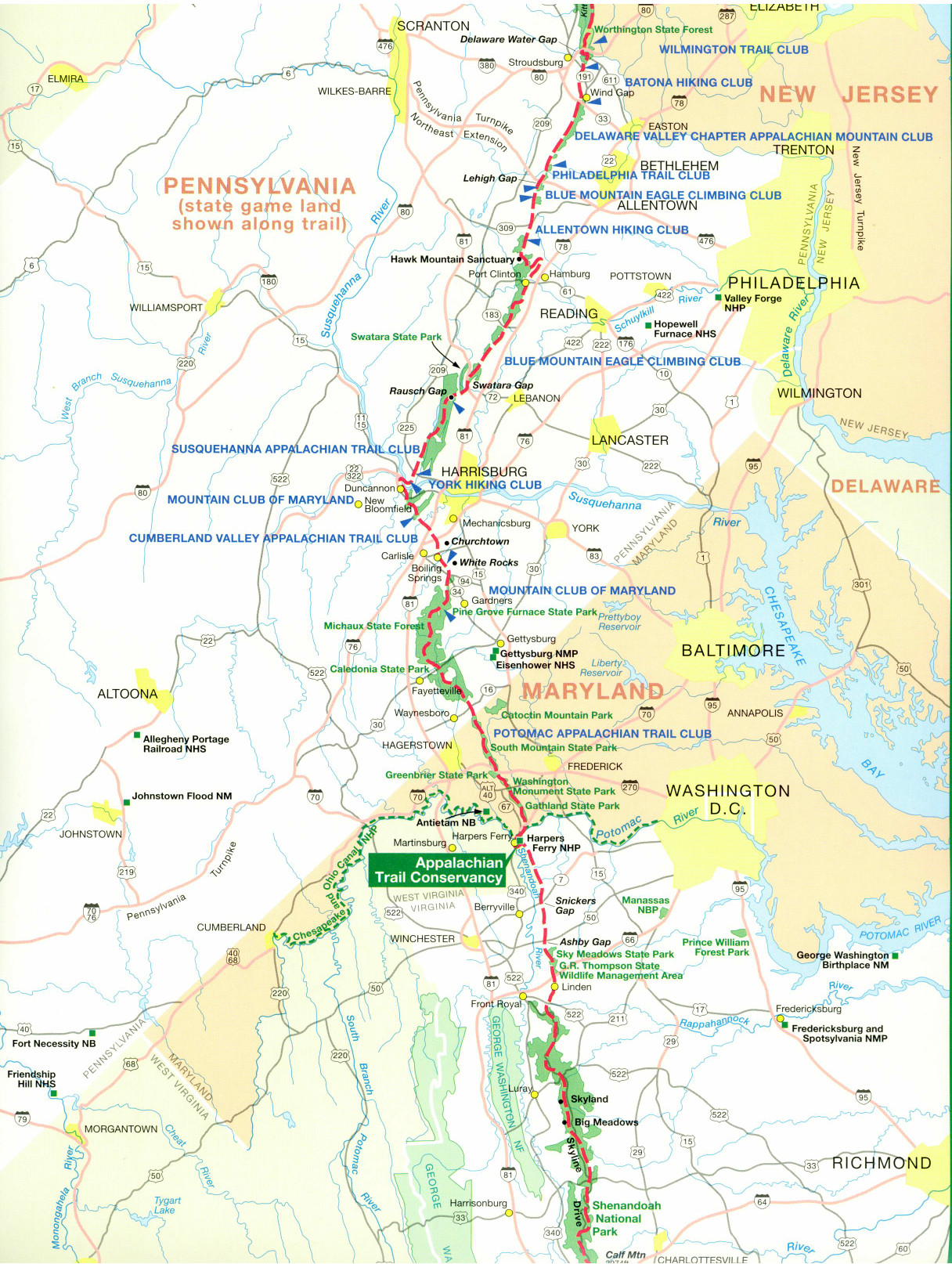
Harper’s Ferry and the nearby Appalachian Trail is one of the most historical sections that hikers ply. After crossing the Susquehanna River the AT turns southward leading over Sharps Mountain where the rocks are Pocono Formation sandstone and siltstone. From there, it plies the spine of Blue Mountain until it drops into the Cumberland Valley. There it seems a love/hate relationship develops between the thru-hiker and the valley. This arises from the fact that the hiker has left the boulder strewn higher trails and has descended into a flat expanse of low country. Down here it can be oppressively hot and shade is at a premium, but it’s actually a fairly pleasant area for a residential community. The ATC has for years been trying to relocate the Trail to a more remote ridge-top route. The next big climb, South Mountain can be viewed for miles before the ascent. Finally back in the woods and shade, you are in precipitous country here with sharp ridges and sheer cliffs. The surrounding ridges are littered with the remains of the old iron industry. There are reminders all the way along to the Maryland border of the industry that thrived here from the Revolutionary War up through the War of Northern Aggression (Civil War).
As the AT descends back down to Caledonia Gap, history hits you slap in the face. It was through this gap in the mountains that Robert E. Lee led his army on their way to Gettysburg in late June of 1863. It was also near here that John Brown carried out raids against government agents in 1859. Just south of the AT stands Sharpsburg, Maryland, where in 1862, Generals Lee and McClellan fought the bloodiest battle in the War (Antietam).
The AT cuts the Mason-Dixon Line and the hiker is finally in the “True South” at the Pennsylvania – Maryland border. This section of the trail is one of many ghosts. The story of these hills is written in their blood. The very same gaps, mountains, and settlements on the AT maps of today, appeared on the maps of the French during the French and Indian War. Harpers Ferry is among the most contested spots in American history.
Sam and Sallie made it through Turner’s Gap on the AT, on the very same trail that British General Braddock and young officer George Washington traveled with their army to engage the French. After Braddock was killed in battle, Washington and his weary troops stopped while retreating to rest at the South Mountain Tavern which stands today. This part of the trail became the National Road to the West over which some many settlers moved west. Abe Lincoln stayed at the South Mountain Tavern on his way to Congress. This is also Stonewall Jackson country, having seen the General and his troops harass and bloody the nose of the Union’s finest on several occasions during the early months of the War.
Interestingly, the AT follows a stone wall for a ways here. The wall denotes a boundary that was surveyed by a 17-year old George Washington. The oldest national monument to George Washington stands nearby. The stone tower was built in 1827, almost 75-years prior to the “famous” monument in D.C.
Sam’s shoes are holding up well on this part of the trail. His only gear problem at the moment is a broken hiking staff. The fine folks at Leki, the manufacturer, said “no problem” and dropped another set in the mail right away. Sam is carrying about 40-pounds in his pack now. This includes about 16-pounds of food – enough for four to five days. The re-supply stops are more frequent here since the wilderness is somewhat “thinner” shall we say.
Sallie’s doing great! She is so devoted to Sam. Her weight is steady now at around 60-pounds. She continues to carry her own rations and gear. More of a concern now that the temps are getting up into the nineties is Sallie’s long, thick coat of jet-black hair or fur. Sam’s begun looking for a groomer to shear some of that hot coat from Sal so she’ll have a cooler time of it.
Sunday, the pair made it into Harpers Ferry and happened upon another thru-hiker who resides there. In typical “trail angel” manner, he invited Sam and Sallie to stay at his place. Wow, a real bed and home cooked meal or two! He even drove Sam to the Post Office to pick up his mail drop and then to the market for a few food items. Monday afternoon found Sam, friend, and Sallie all out in the Potomac River on rafts and tubes escaping the heat.
Tuesday morning it’s back to reality and the trail. The next big supply stop will be Front Royal, Virginia at the head of the Shenandoah Valley and the start of the Blue Ridge Mountains. From this point on, the trail turns decidedly vertical with its’ highest peaks to come in the next couple of months in North Carolina and Tennessee. Before that, Sam and Sallie have to cover some 533-miles of trail in the state of Virginia, the longest state section on the trail. If their current pace holds up, Sam expects to make North Carolina in just 4-weeks, which will be quite a feat. Of course, Sallie expects to be right there when they cross into Tar Heel country as well.
Don’t forget the emails with comments, questions, or encouragement should be sent to Sam and Sallie at mclemoresam@yahoo.com. Your prayers and heartfelt wishes help Sam and Sallie with every step. Also check out Paul Ott’s “Listen to the Eagle” radio show next Monday evening 6-8 p.m. when Sam will call in to discuss his experience on the Appalachian Trail with Paul and Woody. Until next time, you can keep up with Sam’s travels on http://Samboat@blogspot.com.
Sam and Sallie turned their faces to the south last week and despite a torrential rain storm or two and some unseasonably hot weather, they racked up 130-miles in seven days, an average of 17+miles per day.
Sunday, August 9th, fresh from a good night’s rest, having had a visit from his sister Meredith the day before, Sam put Duncannon, Pennsylvania behind him and headed to Harper’s Ferry, West Virginia about 136-miles down trail.
Harper’s Ferry and the nearby Appalachian Trail is one of the most historical sections that hikers ply. After crossing the Susquehanna River the AT turns southward leading over Sharps Mountain where the rocks are Pocono Formation sandstone and siltstone. From there, it plies the spine of Blue Mountain until it drops into the Cumberland Valley. There it seems a love/hate relationship develops between the thru-hiker and the valley. This arises from the fact that the hiker has left the boulder strewn higher trails and has descended into a flat expanse of low country. Down here it can be oppressively hot and shade is at a premium, but it’s actually a fairly pleasant area for a residential community. The ATC has for years been trying to relocate the Trail to a more remote ridge-top route. The next big climb, South Mountain can be viewed for miles before the ascent. Finally back in the woods and shade, you are in precipitous country here with sharp ridges and sheer cliffs. The surrounding ridges are littered with the remains of the old iron industry. There are reminders all the way along to the Maryland border of the industry that thrived here from the Revolutionary War up through the War of Northern Aggression (Civil War).
As the AT descends back down to Caledonia Gap, history hits you slap in the face. It was through this gap in the mountains that Robert E. Lee led his army on their way to Gettysburg in late June of 1863. It was also near here that John Brown carried out raids against government agents in 1859. Just south of the AT stands Sharpsburg, Maryland, where in 1862, Generals Lee and McClellan fought the bloodiest battle in the War (Antietam).
The AT cuts the Mason-Dixon Line and the hiker is finally in the “True South” at the Pennsylvania – Maryland border. This section of the trail is one of many ghosts. The story of these hills is written in their blood. The very same gaps, mountains, and settlements on the AT maps of today, appeared on the maps of the French during the French and Indian War. Harpers Ferry is among the most contested spots in American history.
Sam and Sallie made it through Turner’s Gap on the AT, on the very same trail that British General Braddock and young officer George Washington traveled with their army to engage the French. After Braddock was killed in battle, Washington and his weary troops stopped while retreating to rest at the South Mountain Tavern which stands today. This part of the trail became the National Road to the West over which some many settlers moved west. Abe Lincoln stayed at the South Mountain Tavern on his way to Congress. This is also Stonewall Jackson country, having seen the General and his troops harass and bloody the nose of the Union’s finest on several occasions during the early months of the War.
Interestingly, the AT follows a stone wall for a ways here. The wall denotes a boundary that was surveyed by a 17-year old George Washington. The oldest national monument to George Washington stands nearby. The stone tower was built in 1827, almost 75-years prior to the “famous” monument in D.C.
Sam’s shoes are holding up well on this part of the trail. His only gear problem at the moment is a broken hiking staff. The fine folks at Leki, the manufacturer, said “no problem” and dropped another set in the mail right away. Sam is carrying about 40-pounds in his pack now. This includes about 16-pounds of food – enough for four to five days. The re-supply stops are more frequent here since the wilderness is somewhat “thinner” shall we say.
Sallie’s doing great! She is so devoted to Sam. Her weight is steady now at around 60-pounds. She continues to carry her own rations and gear. More of a concern now that the temps are getting up into the nineties is Sallie’s long, thick coat of jet-black hair or fur. Sam’s begun looking for a groomer to shear some of that hot coat from Sal so she’ll have a cooler time of it.
Sunday, the pair made it into Harpers Ferry and happened upon another thru-hiker who resides there. In typical “trail angel” manner, he invited Sam and Sallie to stay at his place. Wow, a real bed and home cooked meal or two! He even drove Sam to the Post Office to pick up his mail drop and then to the market for a few food items. Monday afternoon found Sam, friend, and Sallie all out in the Potomac River on rafts and tubes escaping the heat.
Tuesday morning it’s back to reality and the trail. The next big supply stop will be Front Royal, Virginia at the head of the Shenandoah Valley and the start of the Blue Ridge Mountains. From this point on, the trail turns decidedly vertical with its’ highest peaks to come in the next couple of months in North Carolina and Tennessee. Before that, Sam and Sallie have to cover some 533-miles of trail in the state of Virginia, the longest state section on the trail. If their current pace holds up, Sam expects to make North Carolina in just 4-weeks, which will be quite a feat. Of course, Sallie expects to be right there when they cross into Tar Heel country as well.
Don’t forget the emails with comments, questions, or encouragement should be sent to Sam and Sallie at mclemoresam@yahoo.com. Your prayers and heartfelt wishes help Sam and Sallie with every step. Also check out Paul Ott’s “Listen to the Eagle” radio show next Monday evening 6-8 p.m. when Sam will call in to discuss his experience on the Appalachian Trail with Paul and Woody. Until next time, you can keep up with Sam’s travels on http://Samboat@blogspot.com.
Listen To The Eagle Show
Paul Ott Carruth and Woody Cain did a short interview with me about Sam and his AT adventures this evening (Monday 8/10). Hopefully we'll hook up with Sam in the next week or two by cell phone and he can tell us all about his trek on the show. Maybe Sallie can throw in a comment or two as well. It should be lots of fun. Tune in every Monday evening from six until eight p.m. at http://www.listentotheeagle.com/index.php?option=com_content&view=article&id=69&Itemid=101 to hear about outdoor sports around our great state of Mississippi.

Summitting Katahdin - Maine is finished 8/4/09
Sam and Dustin have summitted 5267-foot Mt. Katahdin in Maine. This is the northern terminus for the Appalachian Trail and the end of the journey for Dustin, who started his journey of five million steps on February 15th from Springer Mountain, Georgia. For Sam, it's the half-way point. Graduating from MSU in early May, Sam met up with Dustin in Duncannon, Pa on May 15th and since then he has walked 1041 trail miles. Uncounted, however are the miles hiked off the trail as he sought Post Office package drops and re-supply markets. Now Sam and Sallie will double back to Pennsylvania and pick up the trail south. From Duncannon to Springer Mountain the trail measures 1135-miles. Sam expects to finish around the third week of October.
Unfortunately for Sallie, Baxter State Park where Mt. Katahdin is located does not permit dogs, even good ones like Sal. She stayed behind in a kennel near Monson, Maine, Sam and Dustin's last stop before the 100-mile Wilderness. She and Sam have now re-united for their trip south. I'm sure she had plenty of kisses and hugs for her master.
Monson, Maine is the jumping off point for thru-hikers. Here begins the 100-mile Wilderness, a vast area of lakes, forests, and mountains that is uninhabited. All of the land is privately owned, mostly by timber and paper companies. This stretch of trail is cut by only one road - a private gravel logging road with sparse traffic. This if you get into trouble, you are pretty much on your own for self-rescue. Lakes and streams abound in the Wilderness and many sections of the trail have been raised out of the swamps and bogs onto board walks and log bridges constructed by the Appalachian Mountain Club to prevent damage by hikers to the sensitive areas of the eco-system. The rocky areas of the trail are black slate and become extremely slick when wet. Elevations for the Wilderness range from a few hundred feet above sea level to almost 4000-feet. Cutting above surrounding terrain like the blade of an axe, the long ridge of 3,230-foot Big Spencer Mountain once hosted an actively-manned fire tower on its eastern prow. Abandoned for more than a decade, the lookout today rattles with lingering panes of glass and is accessible for those brave enough to clamber up the rusting ladder. Views stretch from Katahdin to Moosehead Lake and encompass virtually the entire 100-Mile Wilderness region. Halfway up the trail, the derelict fire warden's cabin sits open, strewn with old paper records and furniture. The flora of the area includes massive maple trees that are centuries old and beautiful moss and fern covered boulders. There are bears in the Wilderness, but the animal most seen is the moose. You have to be careful around moose as they are extremely territorial and have been known to attack hikers resulting in serious injury.
The northern end of the Wilderness is denoted by the border of Baxter State Park. A very remote wilderness park in itself, Baxter sees many more visitors than the AT south of here. Sam and Dustin made Baxter on Sunday the 2nd and camped prior to taking on Mt. Katahdin on Monday. Weekdays are best for climbing Katahdin as there are fewer people around to spoil the experience. After hundreds of miles and days on the trail in the company of just a few, to end the journey surrounded by a crowd would not be so much fun. Our guys started out on Monday morning with perfect weather. During the last Ice Age, glaciers buried the summits of every mountain in New England - except Katahdin. Here the ice scoured only the mountain slopes, eating away the sides to create a precipitous, razor-sharp ridge: the Knife Edge. A hike across this 1.1-mile arete is an adrenaline-pumping adventure unlike any other in New England, and one that should be on everybody's life list. From Chimney Pond, the very strenuous route ascends the Saddle Trail to Baxter Peak - the terminus of the AT.
All of the gear is holding up well considering the wear and tear it has endured. You last read about Sam's shoe failures. Two pair of Keen long distance trail shoes gave their all but failed after less than a month each on the trail. We talked with Keen numerous times about warranties and finally were able to contact their main guy in Portland, Oregon. He wasn't interested in photos of the failed shoes or sales slips. He took our word for it and not only replaced Sam's two pair of shoes, but also sent him a third pair, just for good measure. Now that's a great American company doing business the old fashioned way and gaining customers by doing it. Our thanks to Keen Footwear of Portland, OR. Check them out - buy their shoes.
According to Sam, the journey so far has been hard, but so worth every moment. The gorgeous vistas, the heights, the thousands and thousands of plants and creatures have stimulated the mind and the shutter finger. He has filled up five memory cards with over 15-thousand photos. We'll be getting our hands on them soon and will be sharing them with you.
From here, Dustin will head back to Mississippi and his family in Indianola. Sam and Sallie will make their way to Millinocket, Maine and rent a car for the journey to Pennsylvania to pick up on their southbound trek. Sam continues to enjoy your emails. While, at the moment he doesn't have the capability to respond. Send Sam and Sallie a note of encouragement to mclemoresam@yahoo.com. So long for now from the Appalachian Trail in Maine.
Unfortunately for Sallie, Baxter State Park where Mt. Katahdin is located does not permit dogs, even good ones like Sal. She stayed behind in a kennel near Monson, Maine, Sam and Dustin's last stop before the 100-mile Wilderness. She and Sam have now re-united for their trip south. I'm sure she had plenty of kisses and hugs for her master.
Monson, Maine is the jumping off point for thru-hikers. Here begins the 100-mile Wilderness, a vast area of lakes, forests, and mountains that is uninhabited. All of the land is privately owned, mostly by timber and paper companies. This stretch of trail is cut by only one road - a private gravel logging road with sparse traffic. This if you get into trouble, you are pretty much on your own for self-rescue. Lakes and streams abound in the Wilderness and many sections of the trail have been raised out of the swamps and bogs onto board walks and log bridges constructed by the Appalachian Mountain Club to prevent damage by hikers to the sensitive areas of the eco-system. The rocky areas of the trail are black slate and become extremely slick when wet. Elevations for the Wilderness range from a few hundred feet above sea level to almost 4000-feet. Cutting above surrounding terrain like the blade of an axe, the long ridge of 3,230-foot Big Spencer Mountain once hosted an actively-manned fire tower on its eastern prow. Abandoned for more than a decade, the lookout today rattles with lingering panes of glass and is accessible for those brave enough to clamber up the rusting ladder. Views stretch from Katahdin to Moosehead Lake and encompass virtually the entire 100-Mile Wilderness region. Halfway up the trail, the derelict fire warden's cabin sits open, strewn with old paper records and furniture. The flora of the area includes massive maple trees that are centuries old and beautiful moss and fern covered boulders. There are bears in the Wilderness, but the animal most seen is the moose. You have to be careful around moose as they are extremely territorial and have been known to attack hikers resulting in serious injury.
The northern end of the Wilderness is denoted by the border of Baxter State Park. A very remote wilderness park in itself, Baxter sees many more visitors than the AT south of here. Sam and Dustin made Baxter on Sunday the 2nd and camped prior to taking on Mt. Katahdin on Monday. Weekdays are best for climbing Katahdin as there are fewer people around to spoil the experience. After hundreds of miles and days on the trail in the company of just a few, to end the journey surrounded by a crowd would not be so much fun. Our guys started out on Monday morning with perfect weather. During the last Ice Age, glaciers buried the summits of every mountain in New England - except Katahdin. Here the ice scoured only the mountain slopes, eating away the sides to create a precipitous, razor-sharp ridge: the Knife Edge. A hike across this 1.1-mile arete is an adrenaline-pumping adventure unlike any other in New England, and one that should be on everybody's life list. From Chimney Pond, the very strenuous route ascends the Saddle Trail to Baxter Peak - the terminus of the AT.
All of the gear is holding up well considering the wear and tear it has endured. You last read about Sam's shoe failures. Two pair of Keen long distance trail shoes gave their all but failed after less than a month each on the trail. We talked with Keen numerous times about warranties and finally were able to contact their main guy in Portland, Oregon. He wasn't interested in photos of the failed shoes or sales slips. He took our word for it and not only replaced Sam's two pair of shoes, but also sent him a third pair, just for good measure. Now that's a great American company doing business the old fashioned way and gaining customers by doing it. Our thanks to Keen Footwear of Portland, OR. Check them out - buy their shoes.
According to Sam, the journey so far has been hard, but so worth every moment. The gorgeous vistas, the heights, the thousands and thousands of plants and creatures have stimulated the mind and the shutter finger. He has filled up five memory cards with over 15-thousand photos. We'll be getting our hands on them soon and will be sharing them with you.
From here, Dustin will head back to Mississippi and his family in Indianola. Sam and Sallie will make their way to Millinocket, Maine and rent a car for the journey to Pennsylvania to pick up on their southbound trek. Sam continues to enjoy your emails. While, at the moment he doesn't have the capability to respond. Send Sam and Sallie a note of encouragement to mclemoresam@yahoo.com. So long for now from the Appalachian Trail in Maine.
Across the White Mountains of New Hampshire 7/8/09
A soggy, tired Sam checked in with us Sunday evening late. Yes, it's started raining again. "There are mudholes on top of the mountains!" Sam exclaimed. Sam, Sallie (5-yr old black lab mix) and Dustin (MSU buddy) are in the heart of New Hampshire near the village of Lincoln where the weather has been unkind to the hikers again. Several days of rain have resulted in some soggy socks and attitudes to go with them, but today there was sunshine and blue skies - so there is hope. Crossing the White Mountains in central New Hampshire, the trio has experienced their first real alpine ecosystem since starting out on their 5-million step journey. The elevations have all been above 3000 feet and for that part of the country, that is just above the tree line. The significance of that comes to light when Sam stated that they had experienced some fairly large hail and a real boomer of a thunderstorm the past couple of days. When you are above the tree line, shelter from a storm comes at a real premium, but the trio have remained unscathed so far.
As mentioned last week, food and supply are more of a focus since re-supply points are getting a little further apart. The diet has unchanged for past couple of weeks with Pop-Tarts and granola bars for breakfast, a couple of peanut butter filled flour tortillas for a mid-morning snack. Dried sausage, pepperoni, or jerky for lunch and a hot meal of soup, noodles, or rice, and sausage for dinner. The rain has made the hot meals more and more difficult, however. The past few days, Sam , Dustin, and Sallie have had the company of a young man from Connecticut, also on his way to Maine. The bonus for the trio is that he is a trained chef and has treated them to several sumptuous trail meals.
Everyone's feet are holding up. Unfortunately, Sam's new shoes - the Keen Targhees are beginning to fail in several places. They are less than a month old. You may remember that his first pair of shoes gave up after a little over a month. They were Keen Shellrocks. We've yet to hear back from Keen Footwear out in Portland about warranty replacements. It's been almost three weeks now. Sallie has stayed clear of the porcupines, but she did catch a rabbit the other day for her meal. Go Sallie!
As with any trail hike of appreciable distance, this hike has had its' share of stream crossings, most without the aid and convenience of a bridge or foot log. Recent rains have swollen small mountain brooks into serious whitewater and the group has had several crossings that were up to their waists and really cold. Safety is the keystone in any adventure and a hike of over 2000-miles will have many challenges along its' route. Sam and Dustin are extremely aware of the risks and back each other up when confronted with a situation.
The daytime temps at the higher elevations have been in the 60's and 70's while after dark, the mercury is dipping into the 40's. Quite a change from back home in Mississippi. As they head into the Presidential Mountain Range of Northeast New Hampshire, they expect to see temps drop into the upper 30's at night as they will start hitting summits at the 4500 to 5000-foot elevations.
From here, Sam, Dustin, and Sallie will bear northeasterly towards Mt. Washington, the tallest peak in the Northeast at 6288-feet. The temperature there on the 4th of July was 30-degrees. Then they will circle around the north and east sides of the mountain before crossing the Androscoggin River at Gorham, New Hampshire, their next mail stop. Sam is enjoying the emails he receives. He generally gets access to a dial-up connection to read his mail so his replies are limited. Shoot Sam and Sallie a note of encouragement to mclemoresam@yahoo.com. So long for now from the Appalachian Trail in New Hampshire.
As mentioned last week, food and supply are more of a focus since re-supply points are getting a little further apart. The diet has unchanged for past couple of weeks with Pop-Tarts and granola bars for breakfast, a couple of peanut butter filled flour tortillas for a mid-morning snack. Dried sausage, pepperoni, or jerky for lunch and a hot meal of soup, noodles, or rice, and sausage for dinner. The rain has made the hot meals more and more difficult, however. The past few days, Sam , Dustin, and Sallie have had the company of a young man from Connecticut, also on his way to Maine. The bonus for the trio is that he is a trained chef and has treated them to several sumptuous trail meals.
Everyone's feet are holding up. Unfortunately, Sam's new shoes - the Keen Targhees are beginning to fail in several places. They are less than a month old. You may remember that his first pair of shoes gave up after a little over a month. They were Keen Shellrocks. We've yet to hear back from Keen Footwear out in Portland about warranty replacements. It's been almost three weeks now. Sallie has stayed clear of the porcupines, but she did catch a rabbit the other day for her meal. Go Sallie!
As with any trail hike of appreciable distance, this hike has had its' share of stream crossings, most without the aid and convenience of a bridge or foot log. Recent rains have swollen small mountain brooks into serious whitewater and the group has had several crossings that were up to their waists and really cold. Safety is the keystone in any adventure and a hike of over 2000-miles will have many challenges along its' route. Sam and Dustin are extremely aware of the risks and back each other up when confronted with a situation.
The daytime temps at the higher elevations have been in the 60's and 70's while after dark, the mercury is dipping into the 40's. Quite a change from back home in Mississippi. As they head into the Presidential Mountain Range of Northeast New Hampshire, they expect to see temps drop into the upper 30's at night as they will start hitting summits at the 4500 to 5000-foot elevations.
From here, Sam, Dustin, and Sallie will bear northeasterly towards Mt. Washington, the tallest peak in the Northeast at 6288-feet. The temperature there on the 4th of July was 30-degrees. Then they will circle around the north and east sides of the mountain before crossing the Androscoggin River at Gorham, New Hampshire, their next mail stop. Sam is enjoying the emails he receives. He generally gets access to a dial-up connection to read his mail so his replies are limited. Shoot Sam and Sallie a note of encouragement to mclemoresam@yahoo.com. So long for now from the Appalachian Trail in New Hampshire.
Out of Muddy Vermont and into New Hampshire 6/30/09
Sallie, Sam and Dustin have completed the 150-miles across Vermont and now find themselves in Hanover, New Hampshire, home of Dartmouth College. Getting to this point was the fun part even though it rained fifteen of the last eighteen days. The weather has dried considerably and temperatures are in the low 80’s-daytime and upper 50’s-nighttime – not bad considering what the temps have been like back in Mississippi.
Everyone’s gear is holding up well. Sam’s new shoes, Keen Targhee hikers are performing well so far. We’ve still not heard from Keen about their warranty on the other failed shoes. Food, from this point on, becomes somewhat of a worry because re-supply points get farther and farther apart as the wilderness closes in. This means that all three trekkers will have to up their loads slightly to have enough supplies to last until the next town.
The AT covers some 161-miles across New Hampshire. Here the trail is nearly all within the White Mountain National Forest. For northbound thru-hikers, it is the beginning of the main challenges that go beyond enduring distance and time: in New Hampshire and Maine, rough or steep ground are more frequent and alpine conditions are found near summits and along ridges. The trail reaches 17 of the 48 “four-thousand footers” of New Hampshire, including Mount Washington, the highest point of the AT north of Tennessee.
Trail hikers like Sam, Dustin and Sallie, who attempt to complete the entire trail in a single season are called "thru-hikers"; those who traverse the trail during a series of separate trips are known as "section-hikers". Rugged terrain and cold weather during the spring and fall make thru-hiking difficult. Traditionally, only about 10% to 15% of those who make the attempt report to the Appalachian Trail Conservancy that they completed it. As of 2007, the total number of reported thru-hike completions since the 1930’s was 9,583. Completion generally requires five to seven months, although some have done it in three months, and several trail runners have completed the trail in less time. Trail runners typically tackle the AT with automobile support teams, without backpacks, and without camping in the woods. The current unofficial speed record for through-hiking the AT was set by trail runner Andrew Thompson in 2005, at 47 days, 13 hours and 31 minutes.
Thru-hikers are classified into many informal groups. "Purists" are hikers who stick to the official AT trail except for side trips to shelters and camp sites. "Blue Blazers" cut miles from the full route by taking side trails marked by blue blazes. The generally pejorative name "Yellow Blazers," a reference to yellow road stripes, is given to those who hitchhike to move down the trail. There are also those who hike the trail in sections known as "sectioners" as opposed to those who hike the whole trail as one course. Most thru-hikers walk northward from Georgia to Maine, and generally start out in early spring and follow the warm weather as it moves north. These "north-bounders" are also called NOBO (NOrthBOund) or GAME (Georgia(GA)-to-Maine(ME)), while those heading in the opposite direction are termed "south-bounders" (also SOBO or MEGA). Part of hiker subculture includes making colorful entries in logbooks at trail shelters, signed using trail names.
Thanks to numerous “trail angels” the trio has shared the comforts of hot home-cooked meals and real beds several nights across Vermont, a real relief considering all the rain and mud. “Slack packing,” having a trail angel shuttle you up the trail and then hiking back to their place that evening while carrying a reduced load day pack is giving the boys a break from the day to day drudgery of forward hiking.
Sallie has recovered from her Porcupine encounter though Sam’s bank account hasn’t. Perhaps she has learned her lesson by now. At least she’s not had an encounter this week.
Next up for the group will be the White Mountains as the trail crosses a myriad of ridges on its way towards Maine. Elevation changes will be the by-word for the rest of the trail as many of the next peaks are in the 2000-foot range with valleys down to the 400-foot levels. Dustin’s mileage to date is 1725-miles, while Sam and Sallie, having joined up with Dustin in Pennsylvania, have completed 600-miles. They are just 441-miles from Mt. Katahdyn, Maine.
You can find an interactive map at http://www.fivemillionsteps.com/trailmap.php. Sam’s blog is http://sambomc.blogspot.com/search and Dustin’s can be found at http://dustinsthruhike.blogspot.com/. They don’t get to update them often, but when they do, it’s a fairly interesting read. Sam appreciates the many emails he’s been receiving from folks back home. He says “keep ‘em coming” to mclemoresam@yahoo.com. Until next time remember
Everyone’s gear is holding up well. Sam’s new shoes, Keen Targhee hikers are performing well so far. We’ve still not heard from Keen about their warranty on the other failed shoes. Food, from this point on, becomes somewhat of a worry because re-supply points get farther and farther apart as the wilderness closes in. This means that all three trekkers will have to up their loads slightly to have enough supplies to last until the next town.
The AT covers some 161-miles across New Hampshire. Here the trail is nearly all within the White Mountain National Forest. For northbound thru-hikers, it is the beginning of the main challenges that go beyond enduring distance and time: in New Hampshire and Maine, rough or steep ground are more frequent and alpine conditions are found near summits and along ridges. The trail reaches 17 of the 48 “four-thousand footers” of New Hampshire, including Mount Washington, the highest point of the AT north of Tennessee.
Trail hikers like Sam, Dustin and Sallie, who attempt to complete the entire trail in a single season are called "thru-hikers"; those who traverse the trail during a series of separate trips are known as "section-hikers". Rugged terrain and cold weather during the spring and fall make thru-hiking difficult. Traditionally, only about 10% to 15% of those who make the attempt report to the Appalachian Trail Conservancy that they completed it. As of 2007, the total number of reported thru-hike completions since the 1930’s was 9,583. Completion generally requires five to seven months, although some have done it in three months, and several trail runners have completed the trail in less time. Trail runners typically tackle the AT with automobile support teams, without backpacks, and without camping in the woods. The current unofficial speed record for through-hiking the AT was set by trail runner Andrew Thompson in 2005, at 47 days, 13 hours and 31 minutes.
Thru-hikers are classified into many informal groups. "Purists" are hikers who stick to the official AT trail except for side trips to shelters and camp sites. "Blue Blazers" cut miles from the full route by taking side trails marked by blue blazes. The generally pejorative name "Yellow Blazers," a reference to yellow road stripes, is given to those who hitchhike to move down the trail. There are also those who hike the trail in sections known as "sectioners" as opposed to those who hike the whole trail as one course. Most thru-hikers walk northward from Georgia to Maine, and generally start out in early spring and follow the warm weather as it moves north. These "north-bounders" are also called NOBO (NOrthBOund) or GAME (Georgia(GA)-to-Maine(ME)), while those heading in the opposite direction are termed "south-bounders" (also SOBO or MEGA). Part of hiker subculture includes making colorful entries in logbooks at trail shelters, signed using trail names.
Thanks to numerous “trail angels” the trio has shared the comforts of hot home-cooked meals and real beds several nights across Vermont, a real relief considering all the rain and mud. “Slack packing,” having a trail angel shuttle you up the trail and then hiking back to their place that evening while carrying a reduced load day pack is giving the boys a break from the day to day drudgery of forward hiking.
Sallie has recovered from her Porcupine encounter though Sam’s bank account hasn’t. Perhaps she has learned her lesson by now. At least she’s not had an encounter this week.
Next up for the group will be the White Mountains as the trail crosses a myriad of ridges on its way towards Maine. Elevation changes will be the by-word for the rest of the trail as many of the next peaks are in the 2000-foot range with valleys down to the 400-foot levels. Dustin’s mileage to date is 1725-miles, while Sam and Sallie, having joined up with Dustin in Pennsylvania, have completed 600-miles. They are just 441-miles from Mt. Katahdyn, Maine.
You can find an interactive map at http://www.fivemillionsteps.com/trailmap.php. Sam’s blog is http://sambomc.blogspot.com/search and Dustin’s can be found at http://dustinsthruhike.blogspot.com/. They don’t get to update them often, but when they do, it’s a fairly interesting read. Sam appreciates the many emails he’s been receiving from folks back home. He says “keep ‘em coming” to mclemoresam@yahoo.com. Until next time remember
Mt. Greylock - On the AT with Sam 6/18/09
Sam, Sallie, and Dustin are in Massachusetts and have traversed the 3451-foot Mt. Greylock, the tallest peak in the commonwealth. This part of Massachusetts is called the "Lake Region of America." According to Sam, it should be called "Marshachusetts" since it has rained for seven of the past nine days. Not just sprinkles, mind you, but torrential downpours spiced up with the occasional 15-minutes of quarter size hail. Altogether, the experience has been "draining" to say the least.
As they sat in camp a few evenings ago, Dustin spotted a bear trotting down the trail right into their campsite. He and Sam started yelling and making noise. The bear took note of the commotion ahead and decided to retreat. Sallie never knew the bear was there, bless her heart.
The trio is averaging just under 15-miles a day still, even with the rain and mud. Hot meals are reserved for the evening since the rain makes everything, including cooking, more difficult. Pop tarts and granola bars along with peanut butter tortillas sustain the hikers during the daytime. That hot evening meal now consists of soups, rice, noodles, and instant mashed potatoes. The last couple of days however, they have enjoyed the hospitality of "trail angel" Tom LaVerdi of Dalton, Mass. Tom has fed them wonderful pasta dishes each day and then shuttled them up the trail so they could "slackpack" back to his place. Dalton, by the way, is where the special paper used in our currency is manufactured. It's a sleeply little town located halfway between Boston and New York City. Thus it is a vacation mecca for all the city dwellers who want to get out and enjoy the mountains.
Sallie, who most of the time is a fast learner, has had yet another encounter with a porcupine. This time she was impaled with over 25-quills necessitating a trip to the local animal clinic and anethesia to remove the painfull darts that were in her lips, gums, and mouth. Ouch! Poor Sal! She's recovering nicely and enjoying a couple of "zero mile" days while Sam and Dustin slackpack.
Vermont is tomorrow. It just 7-miles from Dalton. Sam says that everyone coming down the trail is calling it "Vermud" what with all of the rain falling the last week or so. That will put them about 608-miles from Mt. Katahdin, Maine. Dustin, starting from Springer Mountain, Ga. has walked over 1560-miles at this point. Way to go Dustin!
Their gear is holding up well, except for Sam's shoes. He selected Shellrock Mid Waterproof hikers manufactured by Keen. They had a good rep for trail shoes, but his have given up the ghost after less than 400-miles of trail. The soles are worn completely smooth and the fabric sides has begun to split and turn loose. I'll be in contact with Keen to see if they will live up to their warranty. More on that next post.
Next up for our trio will be the Green Mountains of Vermont and the Green Mountain National Forest of Southwestern Vermont. Until next time.
"Inch by Inch Life's a Cinch, Yard by Yard, Life is Hard!"
Kmac
As they sat in camp a few evenings ago, Dustin spotted a bear trotting down the trail right into their campsite. He and Sam started yelling and making noise. The bear took note of the commotion ahead and decided to retreat. Sallie never knew the bear was there, bless her heart.
The trio is averaging just under 15-miles a day still, even with the rain and mud. Hot meals are reserved for the evening since the rain makes everything, including cooking, more difficult. Pop tarts and granola bars along with peanut butter tortillas sustain the hikers during the daytime. That hot evening meal now consists of soups, rice, noodles, and instant mashed potatoes. The last couple of days however, they have enjoyed the hospitality of "trail angel" Tom LaVerdi of Dalton, Mass. Tom has fed them wonderful pasta dishes each day and then shuttled them up the trail so they could "slackpack" back to his place. Dalton, by the way, is where the special paper used in our currency is manufactured. It's a sleeply little town located halfway between Boston and New York City. Thus it is a vacation mecca for all the city dwellers who want to get out and enjoy the mountains.
Sallie, who most of the time is a fast learner, has had yet another encounter with a porcupine. This time she was impaled with over 25-quills necessitating a trip to the local animal clinic and anethesia to remove the painfull darts that were in her lips, gums, and mouth. Ouch! Poor Sal! She's recovering nicely and enjoying a couple of "zero mile" days while Sam and Dustin slackpack.
Vermont is tomorrow. It just 7-miles from Dalton. Sam says that everyone coming down the trail is calling it "Vermud" what with all of the rain falling the last week or so. That will put them about 608-miles from Mt. Katahdin, Maine. Dustin, starting from Springer Mountain, Ga. has walked over 1560-miles at this point. Way to go Dustin!
Their gear is holding up well, except for Sam's shoes. He selected Shellrock Mid Waterproof hikers manufactured by Keen. They had a good rep for trail shoes, but his have given up the ghost after less than 400-miles of trail. The soles are worn completely smooth and the fabric sides has begun to split and turn loose. I'll be in contact with Keen to see if they will live up to their warranty. More on that next post.
Next up for our trio will be the Green Mountains of Vermont and the Green Mountain National Forest of Southwestern Vermont. Until next time.
"Inch by Inch Life's a Cinch, Yard by Yard, Life is Hard!"
Kmac
Rain, Rain, and More Rain 6/15/09
Sam, Sallie, and Dustin made it to Salisbury, Connecticut today where they'll get to dry out. Salisbury is a very small hamlet in the northwestern part of the state (see attachment for map). The AT runs through Cobble Park which affords a nice, quiet camping spot while you walk the half mile to the Post Office to pick up any mail from home. Sam will pick up a box of home made (Mom's finest) brownies and a couple of memory cards she sent for his camera.The past couple of days have been very wet with rain falling almost all of the time. It's a challenge walking a mountain trail that is wet and slippery. Good footing is at a premium and mud is on discount - it's everywhere. Wednesday night, with rain falling, Sam pitched his covered hammock just after sunset and turned in. He said that he was in the crook of a mountain brook and it was really making noise with all of the run-off from the rain. The restful sounds of water running was soon interrupted by Sallie who had laid down underneath Sam's bivy and was snoring loudly. It's just 690-miles from Salisbury to Mt. Katahdyn, Maine. The trail is now hitting the Berkshire foothills, precursor to the beautiful Berkshire Mountains of Western Massachusetts. The hikers will make it to Massachusetts by Saturday where the hills become mountains - some rising to 2000 feet or more. This is quite a change from the 500-foot hills of New York and Connecticut. The higher elevations also bring cooler temps, especially in the night time. Mount Greylock at 3491-feet is the highest point on the Massachusetts section of the trail. Ninety miles across the state to the Vermont border will take about 7-days.So far, no injuries, just some tired feet, both human and canine. Sallie has taken to lying down anytime the two boys stop on the trail. She has decided that it's much better to conserve her energy than to chase squirrels, chipmunks, or investigate porcupines. Nutrition is the keystone of any trek, but more especially on one that covers almost 2200-miles and consumes 6-months of your life. Lots and lots of high protein food is required and at least two of your daily meals should be hot ones. When it comes to heating your food on the trail, there are literally hundreds of choices in stoves from high tech to low tech. Most of the high tech stoves do a great job cooking, but they are expensive both in cost and weight. Some even require special fuels that may not be available at all places along the trail. Many AT through-hikers choose a home built alcohol stove fashioned from the bottoms of two aluminum pop cans. One bottom is inverted and pressed down into the other can bottom. Several holes are punched around the upper rim of the top can. When filled with just one ounce of fuel alcohol and lit, this little contraption can bring a quart of water to a boil in about five minutes. The best part is that it weighs less than two ounces, including the fuel. You can take a look at how to make one and watch it work on YouTube at http://www.youtube.com/watch?v=e9nQen6i8Mo or if you are interested in more detailed instructions, go to http://zenstoves.net/.Sam's blog is updated whenever he can get to a computer along the trail. You can access the blog at http://sambomc.blogspot.com/2009_01_01_archive.html. He really appreciates any email that you care to send his way. That address is mclemoresam@yahoo.com.Until the next update from the Appalachian Trail with Sam, Sallie, and Dustin. So long for now."Inch by Inch, Life's a Cinch!, Yard by Yard, Life's HARD!!!"Kmac
Across the Hudson 6/7/09
Sam, his Lab Sallie, and friend Dustin crossed into New York State Thursday, June 4th. On Saturday the trio spotted the Empire State Building from the top of Bear Mountain, a thousand foot rise over the Hudson River. What a milestone! Now just 24-miles from Manhattan, the hikers are on a northeasterly heading and have crossed Bear Mountain Bridge over the Hudson. This bridge is just about a mile south of the United States Military Academy at West Point. Across the river on the east side, the higher parts of the trail are just 500-feet above sea level, but the terrain gets chopped up with continuous hills and valleys. The land is similar to the hills and gulleys around Grand Gulf, just taller hills.
The menu for this part of the trail is a variety of dry soup mixes with rice or noodles added for carbs. Protein comes from summer sausage and dried meats which are added to the brew. Intake approaches the five to six thousand calorie mark as the group covers some 15-18 miles a day. As for Sallie, she carries her own rations, water, boots, and ground tarp in her backpack. Daytime temps have been in the upper 70's and low 80's with night time lows sometimes in the 50's. The major rain system that swept through the Northeast earlier in the week just barely grazed the AT, so the hikers enjoyed full days of trekking.
On the trail last Wednesday, they met another "trail angel," the former mayor of the small hamlet of Brooksville, New York. Sam, Sallie, and Dustin spent the night at the mayor's house, along with about 12-other hikers. Thursday morning they got into the mayor's truck, and he dropped them off about 17-miles up the trail. They walked back south that day with just small day packs. Returning to the mayor's place, they were fed another great meal. Friday morning, the mayor shuttled the three back up the trail where they continued their journey north. This process of shuttling forward and walking back with a reduced load is called "slack-packing."
The Connecticut state line is just 40-miles ahead. They should arrive there Tuesday evening. From there Sam, Sallie, and Dustin turn north through the Housatonic River Valley and Massachusetts. Just 770-miles to go to reach Mount Katahdin in Maine. Next week, we'll have a video of Sam's trail stove. So long until the next update.
"Inch by Inch, Life's a Cinch!, Yard by Yard, Life's HARD!!!"
Kmac
The menu for this part of the trail is a variety of dry soup mixes with rice or noodles added for carbs. Protein comes from summer sausage and dried meats which are added to the brew. Intake approaches the five to six thousand calorie mark as the group covers some 15-18 miles a day. As for Sallie, she carries her own rations, water, boots, and ground tarp in her backpack. Daytime temps have been in the upper 70's and low 80's with night time lows sometimes in the 50's. The major rain system that swept through the Northeast earlier in the week just barely grazed the AT, so the hikers enjoyed full days of trekking.
On the trail last Wednesday, they met another "trail angel," the former mayor of the small hamlet of Brooksville, New York. Sam, Sallie, and Dustin spent the night at the mayor's house, along with about 12-other hikers. Thursday morning they got into the mayor's truck, and he dropped them off about 17-miles up the trail. They walked back south that day with just small day packs. Returning to the mayor's place, they were fed another great meal. Friday morning, the mayor shuttled the three back up the trail where they continued their journey north. This process of shuttling forward and walking back with a reduced load is called "slack-packing."
The Connecticut state line is just 40-miles ahead. They should arrive there Tuesday evening. From there Sam, Sallie, and Dustin turn north through the Housatonic River Valley and Massachusetts. Just 770-miles to go to reach Mount Katahdin in Maine. Next week, we'll have a video of Sam's trail stove. So long until the next update.
"Inch by Inch, Life's a Cinch!, Yard by Yard, Life's HARD!!!"
Kmac
From a former trail hiker
I have enjoyed reading your posts on Sam’s trip. When I was 11 or 12 my parents sent me to a summer camp for boys at Tuxedo, NC (near Ashville). I canoed and sailed some, but mostly went on the hikes. I was there for six weeks and took a number of 2 and 3 night trips around the area. I was selected for the two “honor” hikes, one was a gorge hike in which we hiked in and along a river gorge for 4 days, beautiful but wet. The last one was a 7 day hike on the Appalachian Trail. We got off at Clingman’s Dome , but I am damned if I can remember where we got on. We saw Fontana damn but I can’t remember if it was at the beginning or the end or along the way. We carried everything on our backs, food, old style heavy sleeping bag, no pad, and a shelter half. One of the guys had a Trapper Nelson backpack and it was considered state of the art. I had a Boy Scout Yucca Pack for all my previous hikes, but by the end I had a cheap aluminum frame-I tied the old canvas pack to it and thought I had died and gone to heaven. The counselors had Swiss Army style rucksacks. We carried round loaves of Pumpernickel bread, peanut butter, chipped beef in the little glass jars, and other heavy food items. We had some freeze dried items that we ate toward the end of the hike, but it was ghastly. We only saw one other group on the trail.
I will never forget the beauty of the trail and how much fun we had on that trip. We were tired, starved, and all stank by the end, but none of us wanted to stop.
Lem
I will never forget the beauty of the trail and how much fun we had on that trip. We were tired, starved, and all stank by the end, but none of us wanted to stop.
Lem
Rocky Pennsylvania 5/29/09
Sam, Dustin and Sally are camped tonight at the 1200 ft level overlooking Rt. 309 near New Tripoli, Pa. In his words, "The AT is amazing! Pennsylvania is rocky like Balboa." He says that the vistas are unbelievable. In this area the AT is following a ridge heading northeast towards the Delaware Water Gap about 35 miles away. The Water Gap is where the trail leaves Pennsylvania and enters New Jersey. They expect to make the Gap by this Thursday evening.The weather has been nice the last few days with highs in the 70's and low's at night around 55. They are getting spotty afternoon showers that they can see coming for miles away. Kind of nice to be able to anticipate weather on the trail.Sally is showing her devotion to Sam. She has chewed through her leash some 10-15 times in last couple of days while waiting on Sam to pick up supplies in town. Each time she was found at the entrance to the store or shop where Sam was. Now Dustin sits with Sally while Sam makes a supply run. She's wearing her rear boots, no need for the front ones just yet. She's spooked and chased countless chipmunks, ground squirrels, and other rodents but when she get's them cornered, she snaps at the air and let's them go on their way. Much fun for her. She did sniff out a baby deer yesterday. After she took a good smell of the little one, she turned to Sam as if to say, "Hey look what I found!" She was content to just look and smell. She beats Sam to the top of every hill.Sam picked up a pair of Leki hiking poles for the trail yesterday. Says they are great and doesn't know how he got along without them. No new equipment issues have arisen. All seems well in East Central Pa.The trail rises from here to the 1500 ft elevation near the Delaware Water Gap and the scenery is constantly changing. Tomorrow they enter an EPA Super Fund Site where zinc was once mined. It's all been reclaimed and restored now, but serves as a reminder of some of the terrible things we do to mother earth.Sam hasn't been able to update his blog or check his email just yet. He hopes to do that by this weekend. For those of you wishing to follow Sam, Dustin and Sally on the interactive map, go to coordinates Lat: 40.70641, Lng: -75.80772 athttp://www.facebook.com/l/;http://www.fivemillionsteps.com/trailmap.php.
All for now
Kmac
All for now
Kmac
On Top of the World - On the AT in Pa.
Sam checked in with us yesterday. By his on admission he is "On top of the world." He was near Port Clinton, Pa. about 10-12 miles north of Reading. This is in Pennsylvania coal country with lots of abandoned and reclaimed strip mines. He says that it is very green there. Temps at night in the upper 40's to daytime highs in the 80's. The trail pretty much follows the ridge line of the mountains from southwest to northeast. Elevations range from 500 to around 1500 feet above sea level. The toughest part of the walk is not the distance but the elevation changes. Some days you experience from five to six thousand feet in elevation change over a ten to fifteen mile walk. That's where the work comes in. Sam claims that this what he has dreamed about and so far everything is going well. The only equipment issue he has experienced has been the premature failure of a seam on the top of one of his shoes. He chose the Keen Shellrock Mid Height Water Proof hiker shoe, a high tech, very lightweight, yet tough piece of gear. Other than breaking them in before the trip, they have less than 60 miles on them - we'll see how well Keen stands behind their gear. A Verizon phone is in the plans for his next stop. AT&T service doesn't cut it on the trail too well, yet Verizon phones work in far more places. We'll continue to keep everyone posted. Don't hesitate to drop Sam an email if you have a minute. mclemoresam@yahoo.com He will appreciate it.
It’s not the mountain we conquer, but ourselves. - Sir Edmund Hillary
Until next update,
Kmac
It’s not the mountain we conquer, but ourselves. - Sir Edmund Hillary
Until next update,
Kmac
Sam starts his thru-hike 5/15/09
Sam graduated from MSU On May 2nd.(PTL) This past weekend he traveled to Duncannon, Pa. to catch up with his friend Dustin on the AT. They are now on their way to Mt. Katahdin, Maine about 1000 miles away. Once there, Dustin who began his trek in February on Springer Mountain in Georgia, will return to Starkville and the rigors of working for a living. Sam will backtrack to Duncannon and begin the trip south to Georgia. The entire trip is some 2,170 miles give or take a few. It takes five million steps to complete the journey. Sam and Sally (his devoted lab/collie mix expect to finish up in early October. Tonight, as I write this Sam and his buddies should be near Swatara State Park in northeast Pennsylvania about 10 miles north of Lebanon near Hershey and Lancaster. The temps the last couple of nights have been in the upper twenties and sixties during the day. We expect to hear from Sam this weekend. He will be updating his blog when he gets access to the web. You may want to check it out - http://sambomc.blogspot.com/2009_01_01_archive.html and bookmark it now so you can keep track of the journey. I will try to keep everyone up to date with timely emails as well. I know Sam will appreciate any emails you want to send his way as well. Contact him at mclemoresam@yahoo.com. We should all keep his darling wife Isabel in our thoughts and prayers as the next 4-5 months may be a trial for her. All for now.
Kmac
Good day to all!!! So Sunday the 17 we headed towards PA, where my awesome buddy Eric & his fiancé opened their newly purchased home to the 5 of us and fed us dinner and breakfast then showed us the way to a local outfitter to pick up last minute supplies. Then it was off to Duncannon where Dustin had gotten off the trail for "Trail Days", which is 1041 miles from Mt. Kathadin Maine. We began our trip walking through town, across the Juanita River, then the Susquehanna River, then up to the ridge top. The second day out someone passing us southbound told us there was some Trail Magic just 5 miles ahead at a road crossing. It was awesome! They fed us frozen fruit, Gatorade, hamburgers & hotdogs. One of them had a pet groundhog. It was an awesome start. We also met two other guys headed to Maine; one named Squeak & the other: WD-40, cool guys from Chicago. Anyhow, Jared and Ali hiked 3 days with us, then had to head back to other obligations, so Sallie, Myco (Dustin's trail name) & I headed north. We have had an awesome time stopping to take in views of PA farmland and even hiking with an Amish Family for a short distance. The flowers & trees blooming are wonderful. We always stop and take pictures of the ones we haven't seen yet, and attempt to identify them. If there is one thing to say about the trail in PA, it's ROCKS!!!-big ones, little ones, sharp ones, slick ones, red ones, black ones, grey ones, the moss covered ones are nice, but lookout on the Lichen covered ones, they are slick as _____!! We were climbing down from Wolf Rocks Overlook where it was too cloudy to look over when I took a spill, but caught the edge with my fingertips saving me from a good 10-foot drop. WHEW!!! I have loved almost every second of the trip so far, my feet have not loved it quite as much as I have, though. Sallie is just as excited every morning as ever to get started walking and she knows when we start putting our packs on that it's time to go and get her pack on. She was tolerating her booties for a while but when they were wet they rubbed her a little too much so she took them off. She has a pair of socks on the way. She loves chasing chipmunks, however she tried to chase a porcupine and wound up with 5-quills in her nose, but it didn't phase her. I am typing this message in the office of The Presbyterian Church of The Mountain in DWG (Delaware Water Gap) PA, we are 894 miles from Katahdin and enjoying the hospitality of the hostel here at the church. We will be back on the trail tomorrow in New Jersey, for the next 70 miles. I apologize for the grammatical errors as I am trying to type quickly. Thank you for your prayers and support!!! Remember, you can read my latest blog at the Blog archive section of http://sambomc.blogspot.com/2009_01_01_archive.html
"Inch by Inch, Life's a Cinch!, Yard by Yard, Life's HARD!!!
Peace, Love, & Happiness to all!!!"
Sambo on the AT
Kmac
Good day to all!!! So Sunday the 17 we headed towards PA, where my awesome buddy Eric & his fiancé opened their newly purchased home to the 5 of us and fed us dinner and breakfast then showed us the way to a local outfitter to pick up last minute supplies. Then it was off to Duncannon where Dustin had gotten off the trail for "Trail Days", which is 1041 miles from Mt. Kathadin Maine. We began our trip walking through town, across the Juanita River, then the Susquehanna River, then up to the ridge top. The second day out someone passing us southbound told us there was some Trail Magic just 5 miles ahead at a road crossing. It was awesome! They fed us frozen fruit, Gatorade, hamburgers & hotdogs. One of them had a pet groundhog. It was an awesome start. We also met two other guys headed to Maine; one named Squeak & the other: WD-40, cool guys from Chicago. Anyhow, Jared and Ali hiked 3 days with us, then had to head back to other obligations, so Sallie, Myco (Dustin's trail name) & I headed north. We have had an awesome time stopping to take in views of PA farmland and even hiking with an Amish Family for a short distance. The flowers & trees blooming are wonderful. We always stop and take pictures of the ones we haven't seen yet, and attempt to identify them. If there is one thing to say about the trail in PA, it's ROCKS!!!-big ones, little ones, sharp ones, slick ones, red ones, black ones, grey ones, the moss covered ones are nice, but lookout on the Lichen covered ones, they are slick as _____!! We were climbing down from Wolf Rocks Overlook where it was too cloudy to look over when I took a spill, but caught the edge with my fingertips saving me from a good 10-foot drop. WHEW!!! I have loved almost every second of the trip so far, my feet have not loved it quite as much as I have, though. Sallie is just as excited every morning as ever to get started walking and she knows when we start putting our packs on that it's time to go and get her pack on. She was tolerating her booties for a while but when they were wet they rubbed her a little too much so she took them off. She has a pair of socks on the way. She loves chasing chipmunks, however she tried to chase a porcupine and wound up with 5-quills in her nose, but it didn't phase her. I am typing this message in the office of The Presbyterian Church of The Mountain in DWG (Delaware Water Gap) PA, we are 894 miles from Katahdin and enjoying the hospitality of the hostel here at the church. We will be back on the trail tomorrow in New Jersey, for the next 70 miles. I apologize for the grammatical errors as I am trying to type quickly. Thank you for your prayers and support!!! Remember, you can read my latest blog at the Blog archive section of http://sambomc.blogspot.com/2009_01_01_archive.html
"Inch by Inch, Life's a Cinch!, Yard by Yard, Life's HARD!!!
Peace, Love, & Happiness to all!!!"
Sambo on the AT
Subscribe to:
Posts (Atom)


 Posts
Posts